

Old newspapers in Lake Champlain, Vermont, North America, show people once driving trucks across the frozen lake. But that scene is now almost history.About half a century ago, the region began to gradually warm. At first, the change was hard to understand. The lake froze every year from 1850 to 1917, and then it froze most years until the 1940s. But in the past decade, there have been more years without freezing than years with freezing. In fact, the lake froze again this February for the first time in seven years.
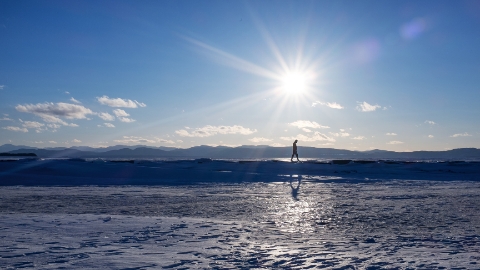
Technically, whether a lake freezes or not may seem like a very small change. If the temperature is just one degree higher, the water remains liquid, and if it is one degree lower, the entire lake is covered in ice. Grace Liu, a machine learning expert at Carnegie Mellon University, says that people usually understand black-and-white information easily. For example, in which years the lake froze and in which years it did not. But people don’t notice the consistent data that shows temperatures are rising slowly over a long period of time.
Suggest Read: What would the sky look like without an atmosphere?
Why we fail to notice climate change even as temperatures rise? Studies have shown that people perceive change more clearly when the data is presented in two categories: “has happened or hasn’t happened.” The first step in addressing climate change is to convince people that the problem is real. But it’s not yet clear how much this awareness will actually encourage people to take action.
New England is one of the fastest-warming regions on Earth. Lake Champlain used to freeze over almost every year, and people would ski or ice-fish there. Now it freezes over every few years. The change isn’t as obvious on a graph of average temperature increases, but the change seems much more dramatic when presented in this “has happened or hasn’t happened” way.
Scientists once thought that major natural disasters like powerful hurricanes, devastating wildfires, or long droughts would wake people up to climate change. But research shows that this doesn’t happen very often.
An analysis of more than two billion social media posts between 2014 and 2016 found that people generally assume that the weather from 2 to 8 years ago is “normal.” As a result, people tend to accept rapid changes as the new normal. Researchers call this phenomenon the “boiling frog effect.” As the story goes, a frog in slowly warming water doesn’t notice the heat.
A study of nearly 500,000 Americans between 2006 and 2022 found that experiencing more than 15,000 natural disasters such as storms, floods, tornadoes, and wildfires did not significantly change people’s beliefs about climate change or their willingness to support environmentally friendly policies.
Why we fail to notice climate change
Researcher Rachit Dubey said that while the pace of global warming over the past two decades has been unprecedented in history, people still see it as a slow change and often convince themselves that it’s not a big problem.
The issue becomes even more ambiguous as generations pass. For example, if a child grows up never seeing a frozen lake, open water in the winter will seem normal to them.The human brain often takes shortcuts. Psychologists say it’s easier to think in black and white because it requires less mental energy. In the past, quickly distinguishing good from bad was crucial for survival. But this way of thinking isn’t always accurate when it comes to modern complex problems.
Climate change information is usually complex and slow, so people don’t easily grasp it. For example, New York used to get regular snowfall in the winter, but now it’s rare. It even snowed again in January 2024 after a 701-day snowless period. Researchers say many regions in the Northern Hemisphere are heading towards a “snow-loss cliff,” where even a small increase in temperature will cause snow to rapidly decrease.
It’s not always easy to present data in two ways, and it loses some of the reality. Still, researchers say that simple, clear examples can help people understand the problem alongside complex data.In some societies, people feel helpless in the face of huge global problems and therefore become indifferent. But in some places, people are starting to think about small, practical solutions. For example, some farmers in Kenya are optimistic about the future despite uncertain rains and are discussing practical steps such as planting trees.
A frozen lake is not only a natural phenomenon, it can also be a clear signal to people. But when that ice melts slowly and the change occurs over years, people often don’t even realize it. I hope you now understand, Why we fail to notice climate change.
Source: sciencenews.org