
There are different types of motion. Each motion has different types, different phases. A special form of periodic motion is simple rhythmic motion. However, it should be remembered that not all periodic motions are simple rhythmic motions. So what is it? The name says it all!
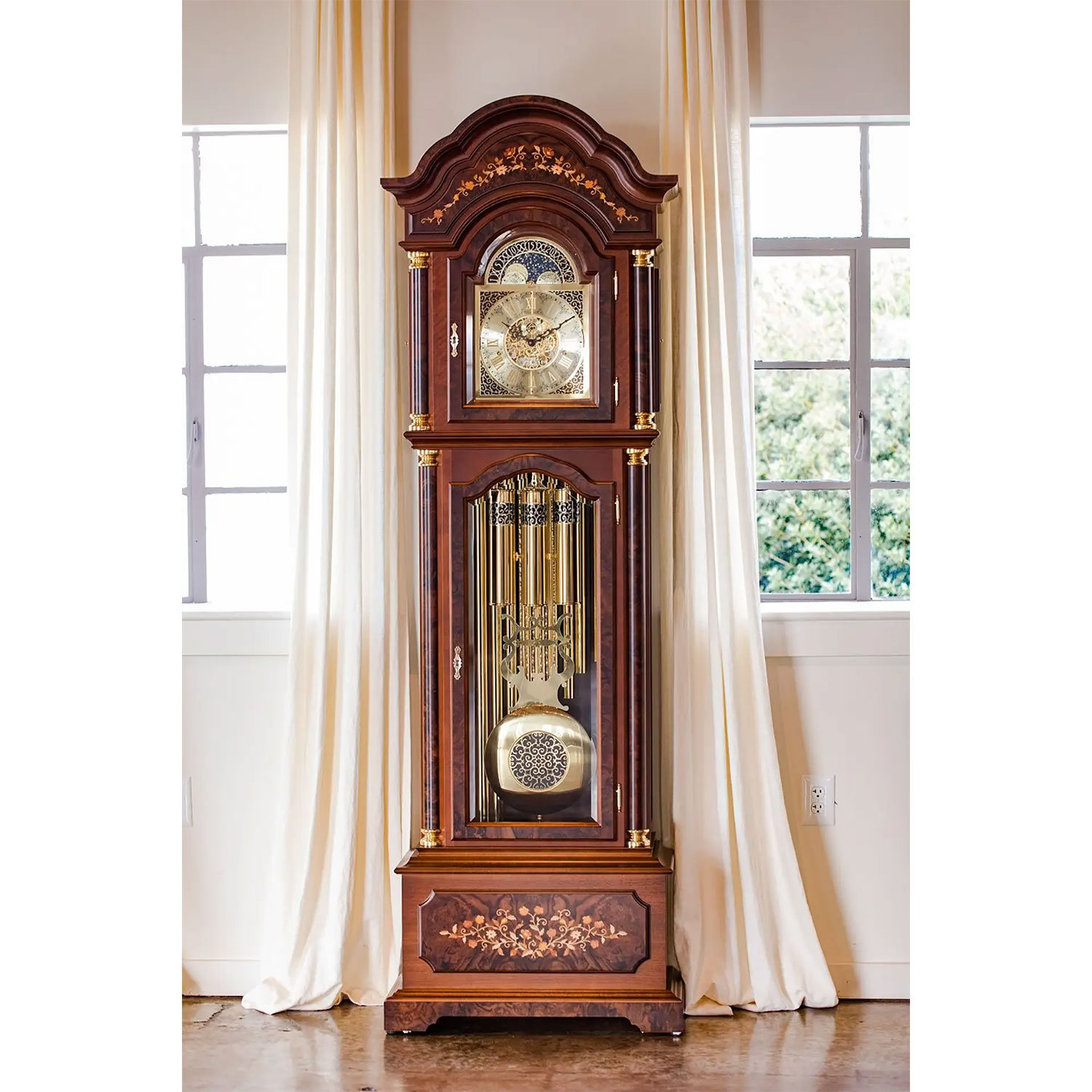 |
| The movement of the seconds hand on a grandfather clock is the most beautiful example of simple rhythmic motion. |
Simple rhythmic motion is a special type of periodic or pulsating motion. In this case, an object vibrates or swings on both sides of a specific point. This specific point is called the equilibrium point or center point. The velocity of the object is maximum at the equilibrium point.
As the object moves forward or backward from the center point, its velocity decreases. Then, at a certain distance (extension or extreme point), the velocity becomes zero. After the velocity becomes zero, the object again moves in the opposite direction, i.e. towards the center point, and the velocity increases with time.
When it returns to the center point, the velocity is maximum again. Then the object moves in the opposite direction due to inertia and reaches the extreme point at the other end, where the velocity is zero again. In this way, the object returns to the center point repeatedly and continues to swing.
The most familiar example of simple rhythmic motion is the simple pendulum. If you hang a heavy object on a string, it swings left and right. When the object swings straight or parallel to the ground, that point is the center point. The movement of the second hand or pendulum of a grandfather clock is the most excellent example of simple rhythmic motion. Apart from this, a baby swing is also a type of simple pendulum.
The scientist Galileo Galilei was the first to do real work on the motion of a simple pendulum. He discovered the character and religion of a simple pendulum by observing the swing of a hanging chandelier in a church.
There are other examples of simple rhythmic motion, not just simple pendulums. The swing of an object suspended on a spring is also an example of simple rhythmic motion. When an object is suspended on a spring and released, the object swings up and down. This up and down simple rhythmic motion is created.
Even when a tuning fork or tuning fork is struck, its two arms vibrate back and forth. As a result, simple rhythmic motion is created. In the seventeenth century, Newton’s contemporary Dutch scientist Christiaan Huygens created a time measuring device using simple rhythmic motion. This clock is now known as a pendulum clock. That is, simple rhythmic motion is widely used in our daily lives as well.
Its importance is immense in physics, especially in phonology. Simple rhythmic motion is closely related to the production of sound somewhere or the speech we are making. It is not enough for a sound to be born, sound waves do the work of delivering it to distant places. The air pushes the sound forward, it is not possible to give a perfect explanation of sound waves with just this information. Only the laws of simple linear motion can provide a scientific explanation of how sound waves propagate, how air molecules vibrate and move the sound forward.
The concept of simple linear motion also plays an important role in explaining the vibration of guitar strings and the process of creating melody. Electrical action is actually the result of vibrational motion. AC or alternating current also obeys the laws of simple linear motion. In AC current, the electric current flows forward once, and then returns to the back again. Therefore, the influence of simple linear motion in electrodynamics is widespread.
Like classical physics, quantum mechanics also uses simple linear motion. Just as particles like atoms or electrons have particle properties, they also have wave properties. Quantum mechanics explains those wave properties. But in quantum mechanics, wave properties did not suddenly fall from the sky! Science has reached its current level only by interpreting, analyzing, and modernizing the formulas of general wave mechanics. So, ultimately, ancient simple rhythmic motion plays a major role in modern quantum mechanics as well.