
Emperor Cichlids Detect Human Gaze
In Lake Tanganyika, one of the world’s oldest and deepest lakes, a fascinating behavioral secret has surfaced about a large native fish known as the Emperor Cichlid; these fish strongly dislike being stared at, especially when the gaze is directed toward their offspring, according to a recent study published in Royal Society Open Science.
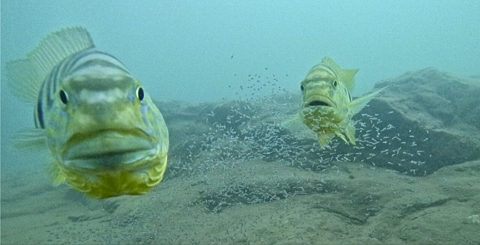
In the animal kingdom, eye contact can function like a silent alarm system, transmitting crucial information without sound; when one member of a group notices a predator watching, others quickly pick up on the danger and become more alert, showing that gaze alone can carry meaning.
Sensitivity to gaze, or the ability to detect where others are looking, has been widely studied in primates and birds, but fish have largely been overlooked; to address this gap, researchers from Japan traveled to Lake Tanganyika to investigate how fish respond when they are being observed.
The research team focused on breeding pairs of Emperor Cichlids, a species known for its size and aggressive parental defense; underwater experiments were conducted to test whether these fish could distinguish between different types of human attention, particularly when a diver was looking at them versus their young.
Suggested: Why we fail to notice climate change
Using underwater cameras, scientists recorded fish behavior across four scenarios involving scuba divers; in one case, divers looked directly at the eggs or fry, in another they stayed nearby but turned their faces away, in a third they oriented their fins toward the nest while turning their bodies away, and in the final scenario they looked directly at the parent fish instead of the offspring.
Three different divers carried out the experiments individually, ensuring that each fish responded to only one human at a time, making the observations more controlled and reliable.
The results revealed a striking pattern; when divers stared directly at the eggs or young fish, the parent cichlids displayed significantly more aggressive behavior compared to when divers looked away or turned their bodies; interestingly, aggression levels were similar whether the divers looked at the offspring or directly at the guarding parents.
This suggests that Emperor Cichlids are sensitive to the direction of attention and may possess a flexible cognitive ability known as attention attribution, which allows them to infer where another creature’s focus lies.
The findings highlight that simply staring at fish or their nests can trigger strong defensive reactions; as scuba diving continues to grow in popularity as a form of marine ecotourism, researchers emphasize the need to consider not only physical environmental impacts but also the psychological stress imposed on aquatic wildlife.
Researchers suggest that minimizing direct staring at fish nests could reduce disturbance. The discovery that Emperor Cichlids detect human gaze adds a new layer to our understanding of fish intelligence and behavior. It shows that underwater life is far more perceptive and responsive than previously imagined.
Source: phys.org