
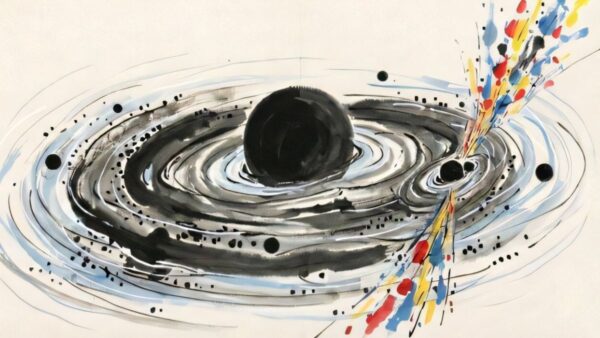
The discovery of colliding black holes light has stunned astronomers and opened a new chapter in space science. In November 2024, scientists observed a rare event where two black holes merged and unexpectedly produced a burst of light in the form of gamma rays and X-rays. This is surprising because black holes are known for not emitting light at all.
Why This Discovery Matters
This discovery changes how scientists understand black hole mergers. It suggests that these events are not always invisible and can sometimes produce detectable light if the conditions are right.
Studying colliding black holes light can help scientists learn more about:
- The environments around supermassive black holes
- The behavior of matter under extreme gravity
- The connection between gravitational waves and light signals
How Scientists Detected Colliding Black Holes Light
The event was first detected through gravitational waves by the LIGO-Virgo-KAGRA observatories. These waves are ripples in space-time created when massive objects like black holes collide. Just 11 seconds after the signal, telescopes captured a flash of high-energy radiation from the same location in space.
This timing strongly suggests that the colliding black holes light was directly linked to the merger event. The probability of this being a coincidence is extremely low, making it one of the most important discoveries in recent astronomy.
Read Also: How long does a planet live?
The Role of Accretion Disks in Producing Light
Scientists believe the merger happened inside an accretion disk, a dense region of gas and dust surrounding a supermassive black hole. These disks are extremely hot and energetic.
When the two smaller black holes merged, the newly formed black hole likely received a powerful “kick” and moved through the surrounding material. This triggered rapid accretion, heating the gas and producing the observed colliding black holes light.
Gamma Rays and X-Rays: The Cosmic Signature
The light detected after the merger included both gamma rays and X-rays, which are forms of high-energy radiation. These signals are usually associated with extreme cosmic events like supernovae or neutron star collisions.
See Also: SpaceX and NASA launch astronauts to relieve bare-bones crew at ISS
However, the unusual pattern of this burst indicates a different origin, supporting the idea that it came from colliding black holes light within a dense environment.
Why Colliding Black Holes Usually Don’t Produce Light
Black holes are famous for absorbing everything, including light. When two black holes merge, the event typically happens in empty space with no surrounding material.
However, the recent observation challenges this idea and shows that under special conditions, colliding black holes light can actually be seen.
Future Research on Colliding Black Holes Light
Researchers are now focusing on finding more events like this to confirm the theory. Future observations will help determine whether this was a rare coincidence or a common phenomenon that has been missed until now.
Suggested: International Space Station Future Plan May Continue Until 2032
If more cases of colliding black holes light are discovered, it could revolutionize our understanding of the Universe and reveal hidden processes happening in distant galaxies.
Conclusion
The detection of colliding black holes light marks a groundbreaking moment in astronomy. It shows that even the darkest objects in the Universe can produce light under the right conditions. As technology improves, scientists expect to uncover more such events, bringing us closer to understanding the deepest mysteries of space.
Source: www.sciencealert.com