
How big can a black hole get: A black hole sounds like a cosmic monster that devours everything in sight, but how large can this “stomach” really become, and could it ever swallow the entire universe? Theoretically, there is no lower limit to the size of a black hole; any object can be compressed enough to become one if its density is increased and its volume reduced so drastically that its escape velocity exceeds the speed of light, meaning not even light can escape.
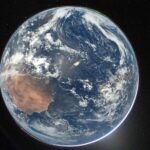
If Earth were compressed to a radius of about 0.35 inches, it would turn into a black hole; likewise, there is no strict theoretical upper limit either, or is there? In the 1960s, astronomers discovered an extremely powerful source of radio waves coming from the Virgo constellation, yet nothing visible appeared there at first; later, a faint blue object was identified, known as 3C 273, which turned out not to be a star but something far more exotic, a quasar. The term quasar comes from “quasi-stellar,” meaning star-like, though these objects are far more massive, energetic, and luminous than stars, often outshining entire galaxies by up to a thousand times the brightness of the Milky Way; they are now understood to be young galaxies powered by supermassive black holes at their centers.
The energy source of 3C 273, for example, is a supermassive black hole with a mass about 900 million times that of the Sun, and many such black holes have since been discovered, including at least dozens with masses exceeding ten billion Suns. By the 1980s, scientists proposed that nearly every galaxy contains a supermassive black hole at its core, a theory later confirmed by observations from instruments like the Hubble Space Telescope, suggesting that there may be around one trillion such black holes in the observable universe. While typical supermassive black holes have masses of hundreds of millions or billions of Suns, some grow even larger, raising the question of whether there is a maximum possible mass; estimates suggest that black holes could reach up to about 100 billion solar masses, roughly comparable to the mass of an entire galaxy, though measuring such extremes is difficult and indirect.
Despite the idea that black holes could eventually consume everything, this scenario is unrealistic because not all matter in the universe will fall within their reach; in 2015, astrophysicist Andrew King proposed that practical limits exist, suggesting black holes may not grow beyond about 50 billion solar masses, with other estimates placing limits near 27 billion solar masses depending on physical conditions. The difference arises because falling into a black hole requires matter to come sufficiently close to its event horizon, and although the black hole itself has no physical size, its gravitational influence extends outward, yet objects beyond a certain distance can still escape.
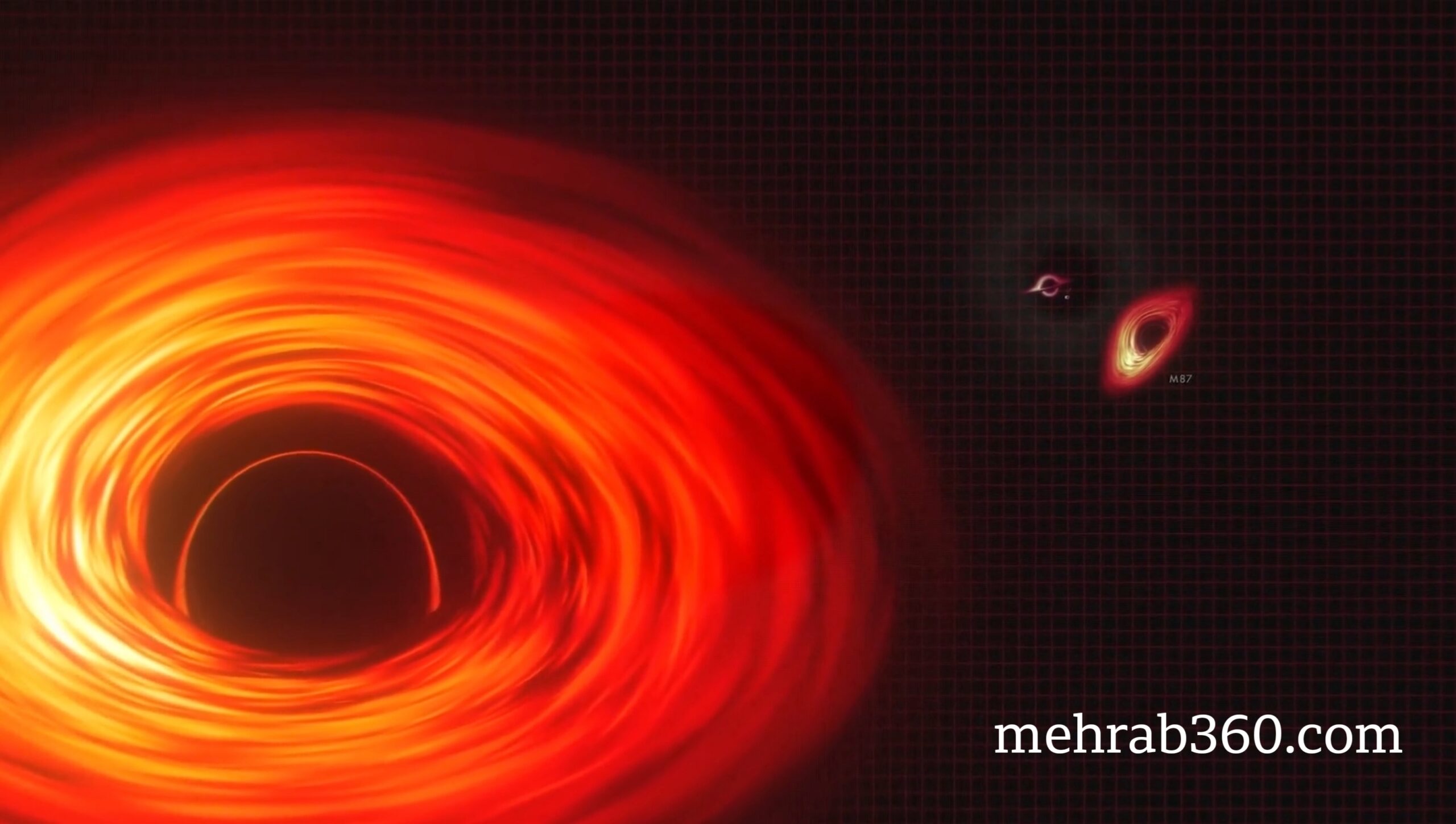
Even the largest known black holes have event horizons about 100 billion kilometers across, comparable to the size of our solar system, which is tiny on cosmic scales; anything beyond that remains safe. If a black hole with the Sun’s mass replaced the Sun, Earth would not be pulled in but would continue orbiting, though life would end due to lack of heat. At the center of our own galaxy lies Sagittarius A*, a black hole about 26,000 light-years away with a mass of around 400 million Suns, yet it has no direct effect on our daily lives. In reality, falling into a black hole is rare and complex; objects usually spiral inward, forming an accretion disk, where intense friction heats matter to millions of degrees, making it glow brightly and revealing the otherwise invisible black hole.
This radiation, along with magnetic forces, can push matter outward, limiting how much material the black hole can consume, a balance known as the Eddington limit, which effectively caps its growth rate. Since the universe itself has a finite age of about 13.8 billion years, black holes have had limited time to grow, meaning their maximum mass is also time-constrained; calculations suggest an upper bound near 270 billion solar masses under ideal conditions, though more realistic scenarios reduce this to about 50 billion solar masses.
Black holes can also grow through mergers when galaxies collide, such as the future collision between the Milky Way and Andromeda billions of years from now, yet even such mergers are unlikely to surpass theoretical limits. One of the largest known black holes, Phoenix A, has an estimated mass of about 100 billion Suns and resides at the center of the Phoenix Cluster, located roughly 8.6 billion light-years from Earth.