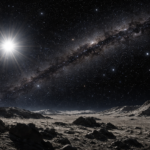

In the pitch-black darkness of space, some planets wander aimlessly, like cosmic nomads with no home and no sun to call their own. These planets have no parent star and no fixed address. Scientists call them rogue planets. Their numbers are far from small. In fact, there may be as many rogue planets in our galaxy as there are stars. Even more astonishing, many of these lonely worlds have their own moons, some of which may be as large as Earth itself. A new study by researcher David Dalbudding and his team at Ludwig Maximilian University of Munich suggests that these distant, drifting moons could contain liquid water, and possibly even life.
 |
| Getty images |
This raises an obvious question: without a sun, where would the heat come from? Without heat, any water should freeze solid. The answer lies in a process called tidal heating. When a massive planet pulls and releases its moon through gravity, it creates internal friction within the moon. This friction generates enormous heat from the inside. In our own solar system, Saturn’s moon Enceladus and Jupiter’s moon Europa both have vast subsurface oceans beneath thick layers of ice because of tidal heating. Even the intense volcanic eruptions on Jupiter’s moon Io are powered not by the sun, but by this same gravitational squeezing.
{inAds}
However, moons like Europa and Enceladus have thick ice shells that trap heat inside. If a rogue moon had liquid water on its surface instead of beneath ice, how would that heat remain trapped? Initially, researcher Julia Rosetti proposed that a thick carbon dioxide atmosphere might act like insulation. But there was a problem. At the extremely high pressures needed to trap heat, carbon dioxide itself would condense into liquid or freeze, causing the atmosphere to collapse and leaving the moon frozen.
{inAds}
Here is where hydrogen gas enters the stage like an invisible thermal blanket. Hydrogen does not easily freeze except at extremely low temperatures. Normally, hydrogen cannot trap heat effectively, and thermal energy escapes into space. But under immense pressure, hydrogen molecules constantly collide with each other in a process called collision-induced absorption. This allows hydrogen to trap heat efficiently, creating a powerful greenhouse effect. As a result, tidal heating alone could keep water in liquid form on the moon’s surface.
{inAds}
Using radiation and chemical models in advanced computer simulations, researchers found remarkable results. If such a moon had an atmospheric pressure similar to Earth’s, liquid water could survive for about 95 million years. Even more astonishing, if the pressure were 100 times greater than Earth’s, liquid water could remain stable for up to 4.3 billion years, roughly the age of Earth itself.
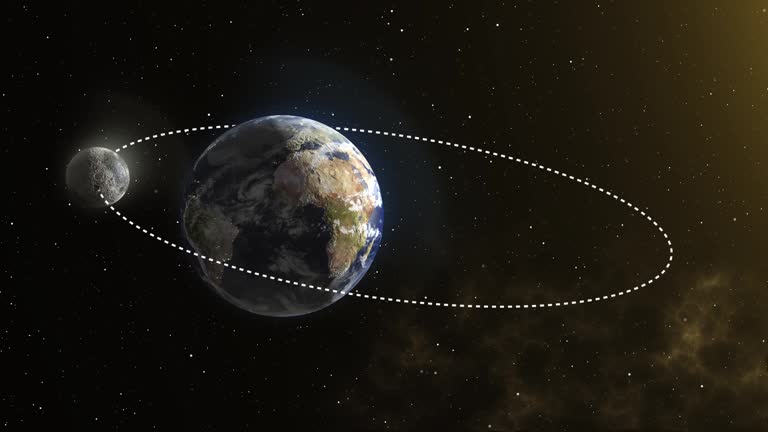
Where liquid water exists, the building blocks of life have a chance to form. These rogue moons often follow elliptical orbits around their planets, creating powerful tidal cycles of flooding and drying. On Earth, tides are caused by the Moon’s gravity. On these rogue moons, the reverse happens: the planet pulls on the moon, generating massive tides. These constant wet-dry cycles provide ideal conditions for forming RNA, one of the most important molecules for life. Scientists believe similar processes may have helped life begin on early Earth.
So far, no such rogue moon has been directly observed. But the laws of physics strongly suggest that billions of them may exist in our galaxy. With rapidly advancing technology, discovering one may only be a matter of time. Perhaps someday, humanity will detect signs of life on a moon drifting through space without a sun. The universe has a habit of hiding life in the most unexpected corners.
Source: Universe Today
Image credits: NASA