
Without Earth’s atmosphere, the sky would appear dramatically different from the familiar blue canopy we see today. Instead of a bright, vibrant blue, the sky would be a deep, endless black, even during the daytime. This is because the blue color of the sky is created by a process called Rayleigh scattering, in which sunlight interacts with the molecules and tiny particles in the atmosphere and scatters in all directions. Blue light, which has a shorter wavelength, scatters more than other colors, and this scattered blue light fills the sky, creating the soft blue dome we see above us.
{inAds}
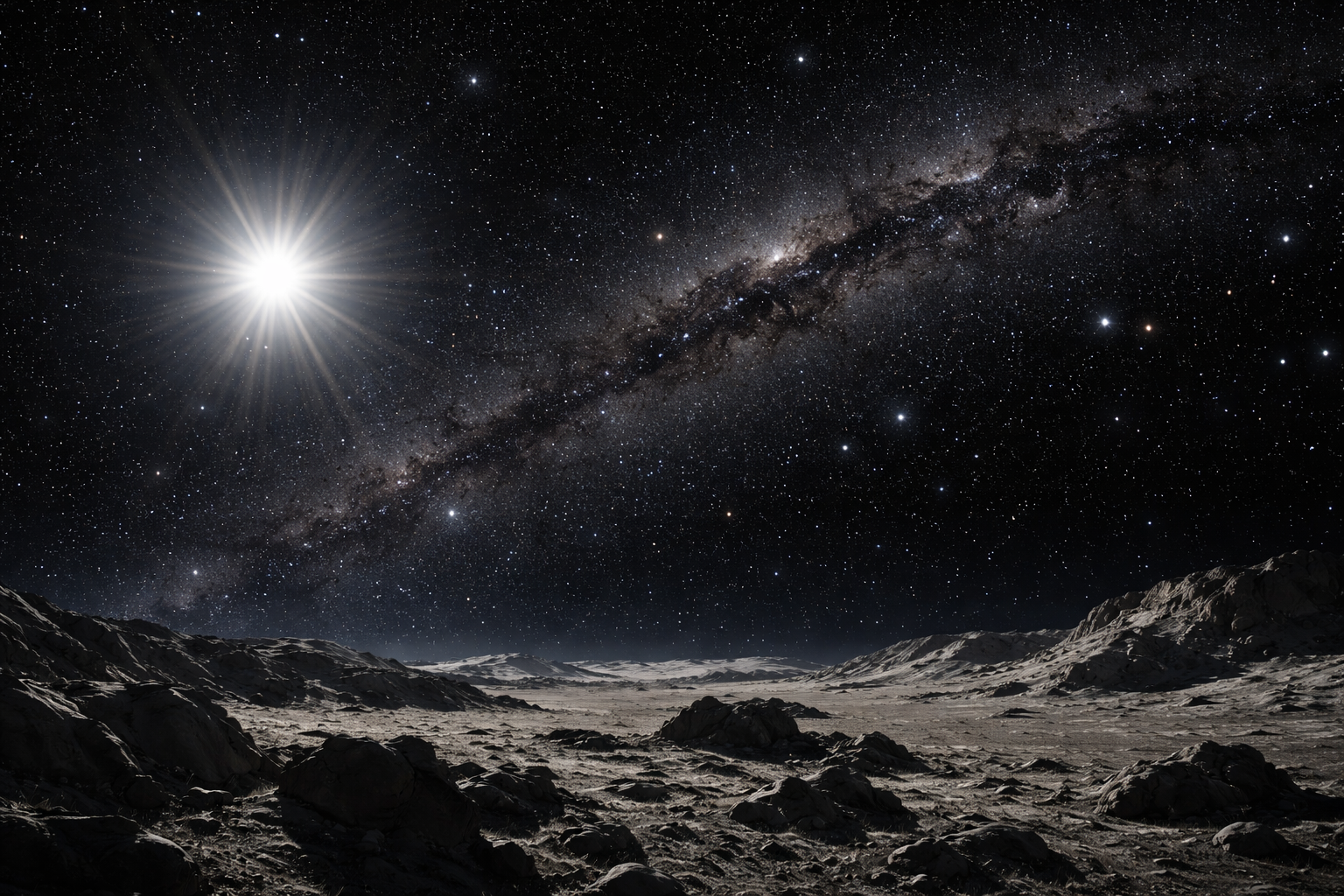
However, if the atmosphere did not exist, there would be nothing to scatter the sunlight. The light would travel directly from the Sun to the surface without spreading across the sky, leaving the background completely black, similar to what astronauts see in space. In such a world, the Sun would still shine intensely, but it would appear as a sharply defined, brilliant disk surrounded by pure darkness rather than a glowing blue background. The contrast would be striking, like a blazing spotlight suspended in an infinite cosmic void. One of the most astonishing changes would be the visibility of stars during the daytime. On Earth today, the scattered sunlight makes the sky so bright that it overwhelms the faint light from distant stars, making them invisible during the day. Without the atmosphere, there would be no scattered light to wash out the stars, so countless stars would remain visible at all times, even when the Sun was high in the sky.
{inAds}
The Milky Way galaxy would stretch across the heavens as a glowing river of light every hour of the day, transforming the sky into a permanent window into the universe. Sunrises and sunsets would also lose their familiar beauty. Currently, when the Sun rises or sets, its light passes through a thicker portion of the atmosphere, scattering shorter wavelengths and allowing longer wavelengths like red and orange to dominate, creating stunning displays of color. Without the atmosphere, this gradual transition would disappear. The Sun would simply appear suddenly above the horizon and disappear just as abruptly, without any colorful glow or fading twilight.
{inAds}
The sky would remain black until the moment the Sun rose, and it would return instantly to darkness when the Sun set. There would be no dawn or dusk, only a sharp switch between light and darkness. Clouds would not exist either, since clouds are formed from water vapor suspended in the atmosphere. Without air, there would be no clouds drifting across the sky, no dramatic storm formations, no lightning flashing through the heavens, and no rainbows arching across the horizon. The sky would be perfectly clear and unobstructed, allowing distant celestial objects to appear sharper and more detailed than ever before. Planets, star clusters, and galaxies would be visible with incredible clarity, turning the sky into a breathtaking cosmic panorama.
{inAds}
However, this beauty would come with serious consequences. The atmosphere acts as a protective shield that absorbs and deflects harmful radiation from the Sun and space. Without it, dangerous ultraviolet rays, X-rays, and cosmic radiation would reach the surface directly, making life as we know it impossible. Additionally, the atmosphere protects Earth from small meteoroids by burning them up through friction before they reach the ground. Without this protective layer, meteoroids would strike the surface far more frequently, and fiery streaks would end in direct impacts rather than harmless flashes in the sky. Another striking difference would be the quality of light and shadow. With no atmosphere to scatter sunlight, shadows would be extremely sharp and dark, with no soft edges. The transition between light and shadow would be sudden and harsh, creating a visually stark and unforgiving landscape. The sky would not have the gentle brightness that gives Earth its welcoming appearance, but instead would feel vast, cold, and infinite.
{inAds}
Looking upward would feel less like gazing at a comforting ceiling and more like staring into an endless abyss. There would also be no blue haze near the horizon. Currently, the atmosphere scatters light in a way that makes distant objects appear slightly bluish and less distinct, creating a sense of depth. Without this effect, distant mountains and landscapes would appear clearer but more stark and lifeless. The sky would lack warmth and softness, replacing them with a stark, cosmic emptiness. This is exactly what astronauts experience on the Moon, where the sky remains pitch black even under direct sunlight. The absence of an atmosphere would make Earth feel more like an exposed rock floating in space rather than a living world wrapped in a protective blanket. Ultimately, the atmosphere does far more than simply color the sky. It creates the familiar blue expanse, enables beautiful sunrises and sunsets, forms clouds and weather, and protects life from the harsh environment of space.
{inAds}
Without it, the sky would be permanently black, filled with stars even during the day, and dominated by the harsh brilliance of the Sun. It would be breathtaking in its clarity but also terrifying in its emptiness, a constant reminder of how fragile and precious Earth’s protective envelope truly is.