

Language is one of humanity’s most astonishing inventions, a cathedral built not of stone but of sound. Yet its birth remains wrapped in mist. Scholars have proposed many theories about how language began. The “Bow-wow” theory suggests that early humans imitated the calls of animals and birds, and over time these echoes evolved into words. The “Ding-dong” theory argues that natural sounds produced by objects formed the raw materials of the first language. Other theories such as the “La-la,” “Pooh-pooh,” and “Yo-he-ho” propose that language grew out of emotional cries, rhythmic chants, and instinctive vocal expressions of joy, pain, or collective labor. Despite these imaginative explanations, the origin of language remains deeply complex and impossible to prove with certainty. In fact, the Société de Linguistique de Paris banned research and debate on the origin of language in 1866 because the subject was considered too speculative.
People across the world speak different languages, forming a vibrant mosaic of human expression. How humans learn language, especially how children acquire it, continues to fascinate linguists, psychologists, and medical researchers. The linguist Noam Chomsky famously compared the human brain to a mysterious black box, suggesting that we are biologically equipped with an innate capacity for language. Children do not require formal instruction to learn their mother tongue; they absorb it naturally from their environment. Similarly, immersion in a different linguistic environment for several months often enables a person to begin speaking a new language.
Humans are the only species with fully developed language, though modern linguistics defines language broadly as a system of communication, which allows us to recognize forms of communication among animals as well. However, unlike other species, humans consciously shape and develop their languages. All languages follow certain structural principles, even though they vary widely. Language is primarily spoken and heard, but it can also be written and seen. Sign languages use hand gestures, while Braille enables communication through touch.
Today, there are more than 6,500 languages spoken worldwide. Among the oldest known languages are Babylonian, Sanskrit, and Egyptian, each with histories stretching back five or six thousand years. Some scholars, such as Professor Tallerman, suggest that the roots of language may extend back at least 50,000 years, while others propose an even deeper origin, perhaps 500,000 years ago. Yet the true age of language remains unknown. No one can predict with certainty which languages will survive in the distant future or what forms they will take.
From 1950 onward, researchers have observed a steady decline in the number of languages spoken globally. More than 40 percent of the world’s languages are now endangered, amounting to nearly 3,000 languages. It is estimated that within the next century, about 90 percent of current languages may disappear. On average, nine languages vanish each year. Although new languages occasionally emerge, there is no strict linguistic criterion for determining when a dialect becomes a separate language.
Many scholars believe that language originally developed to facilitate cooperation in hunting and self-defense in early human societies. Repeated sound patterns gradually acquired shared meanings, transforming meaningless sounds into meaningful words. Spoken language and written language, however, did not arise in the same way. Writing likely evolved from pictographic systems into modern scripts, while spoken language developed from vocal sounds combined into meaningful expressions. Modern linguistics emphasizes that words themselves have no inherent meaning; meaning is assigned by social agreement. The word “rose,” for example, could just as easily have been named something entirely different.
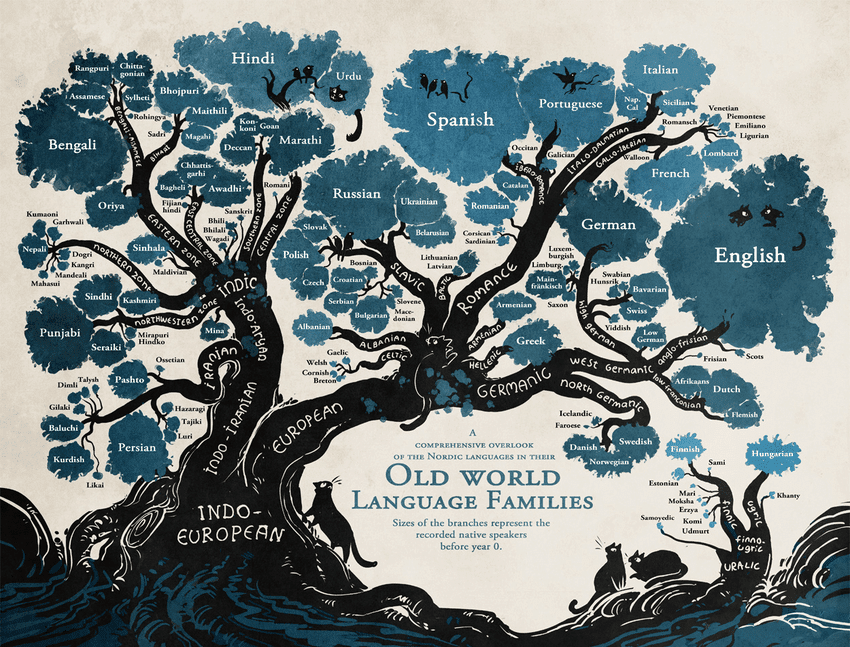
As populations migrated and settled in new regions, linguistic diversity increased. Some linguists hypothesize that all humans once shared a single original language, though its identity may never be discovered. Comparative studies of languages in Europe and Asia led scholars to propose the existence of a common ancestral language known as the Indo-European family. The idea of linguistic relationships across regions was first articulated in 1786 by William Jones.
A language lives through its speakers. If no one remains to speak a language, it is considered dead. Languages may survive in written form, but without living users, they fade from daily life. Language dominance also plays a role in linguistic change and extinction. Powerful nations often promote their languages through political or economic influence. Linguistic contact leads to borrowing, known as adstratum. In some regions, two languages coexist, forming a substratum situation. In others, a dominant language overwhelms local languages, creating a superstratum effect. Long-term contact between languages may produce a pidgin, a simplified means of communication. Over generations, pidgins can develop grammar and become creole languages, adopted as native tongues by new generations.
The idea of a single global language has inspired the creation of Esperanto, a constructed language developed in 1887 by the Polish physician L. L. Zamenhof. Today, approximately 2.5 million people speak Esperanto. Designed for simplicity in pronunciation, spelling, and grammar, it was intended to serve as a neutral international language.
What about the future of language? It is possible that one dominant language may emerge, especially with globalization and technological advancement. Major world languages will continue to evolve, adopting new expressions and discarding old idioms. A few years ago, The Washington Post predicted that by 2050, languages such as Spanish, Portuguese, Arabic, and Russian would remain highly influential in global trade, followed by Hindi, Bengali, Urdu, and Indonesian. Meanwhile, programming languages like Python continue to expand their influence in the digital world.
Language is not a fossil trapped in stone. It is a living river, changing course, merging with others, and sometimes drying up. Its story is inseparable from the story of humanity itself.
Source: www.researchgate.net & Professor, Department of Bengali, University of Dhaka