
We often worry about the difficult mysteries of science. What is a black hole, is time travel possible or not; there is no end to the debate about these. But sometimes some very simple questions come to our mind, the answers to which we may not look for in the same way. For example, why is it easier to swim or float in the sea than in a pond?
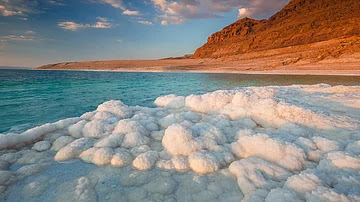
A more interesting question is, is there any place in the world where you can’t drown even if you don’t know how to swim? Yes, there really is such a place. You can float there even if you don’t know how to swim. The Dead Sea, located on the border of Jordan and Israel. This is that place. There, people lie down comfortably and read newspapers, but there is no fear of drowning! Even if you go to the Siwa Oasis in Egypt, you can see this magical phenomenon.
But why? Is there any magic behind it? No, there is science behind it. People can float effortlessly in water due to two small things in physics. One is density, the other is buoyancy. To understand this, we can recall the old school story of the Greek scientist Archimedes. Once, the king gave him the task of testing the gold in the crown. Archimedes had to find out whether the gold contained alloy. He had to do that without breaking the king’s crown. But he couldn’t find a solution. The Dead Sea, located on the border of Jordan and Israel, is that place. There, people lie down comfortably and read newspapers, but there is no fear of drowning!
One day, he got into the bathtub to take a bath. As soon as he got into the water, some of the water in the bathtub overflowed and fell down. Immediately, he started shouting, “Eureka, Eureka.” By “Eureka,” he meant, “I got it! I got it! What did I get? I found a way to prove whether the gold contained alloy.”
In fact, as soon as he got into the bathtub, water equal to the volume of Archimedes’ body overflowed. The interesting thing is that the amount of water that is displaced will also push you in the opposite direction. This push is called buoyancy.
Now the rule is very simple. If the density of your body is greater than the density of water, you will not be able to float in water. That means the water will not be able to keep you afloat. But if the opposite is true? That means if your body density is less than water? Then you will float.
We can usually float in fresh water, meaning in a pond or swimming pool. That is not easy, we can float by moving our arms and legs. Because about 60 percent of our body is water. The amount of water in children’s bodies is even more, about 78 percent. Since our body is mainly made of water, our density is not much higher than the density of water. If we keep our lungs full of air, we float effortlessly.
As soon as we get into the bathtub, water equal to the volume of Archimedes’ body overflows. The interesting thing is that the amount of water that is displaced will push you in the opposite direction. Now let’s come to the story of salt. What happens when you add salt to water? The salt molecules break down and get into the gaps between the water molecules. In chemical terms, the sodium and chloride ions combine with the water and become one.
As a result, the weight or density of the water increases. A glass of salt water is much heavier than a glass of regular water. And the denser or heavier the water is, the more its ability to push upward or buoyancy increases. The amount of salt in the Dead Sea water is much higher than that of regular sea water. If the density of regular water is 1000 kg/cubic meter, then the density of the Dead Sea water is about 1240 kg/cubic meter! This water is so dense that the water pushes your body upward with great force. Even if gravity tries to pull you down, this increased density of water does not allow you to sink. That is why people float effortlessly in the Dead Sea.
Source: IFLScience