

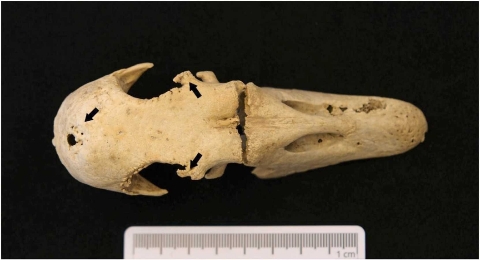
Archaeologists have discovered four rare goose skulls inside a former toilet shaft in Brandenburg, Germany. Each skull contained unusual holes that puzzled researchers at first. After careful examination, they realized the holes were linked to decorative feathered crests, making these the first crested geese ever identified in the archaeological record.
Advertisement
The skulls were uncovered at Flecken Zechlin, about 100 kilometers from Berlin. The site dates back to the 17th century and was once connected to bishops and wealthy aristocrats. According to archaeozoologist Maaike Groot from Freie Universität Berlin, these crested geese were likely kept as luxury animals to display wealth and social status rather than for practical farming.
Advertisement
The researchers found the skulls among chicken and duck bones during excavations carried out between 2021 and 2023. One skull had a hole measuring about 15 millimeters, with part of the skull completely missing. Because the remains were exceptionally well preserved, scientists ruled out damage caused by butchering, animal bites, disease, parasites, or poor nutrition. Instead, the skulls closely matched those of modern crested ducks. The holes were almost identical in size, shape, and position. This comparison led researchers to conclude that the geese also carried feathered crests caused by the same type of genetic condition.
Advertisement
The discovery also reminded Groot of paintings by Dutch artist Melchior d’Hondecoeter, who depicted crested geese during the same period. These paintings, together with the newly discovered skulls, represent the earliest known evidence of crested geese in Europe. Although the feathered crests made the birds attractive, the trait likely caused serious health problems. In crested ducks, the crest develops because of a genetic defect that prevents the skull from closing properly, leaving holes covered only by skin and fat. This condition can increase death rates before and after hatching and may also cause poor coordination, hearing loss, or vision problems. While no detailed studies have been conducted on crested geese, researchers believe they probably experienced similar health issues because ducks and geese are closely related.
Advertisement
The findings suggest that crested geese were present in at least two regions of Northern Europe during the 17th century. However, their history may be even older, as crested chickens were already known during the Roman era. Researchers hope this discovery encourages archaeologists to examine bird skulls more carefully in future excavations and helps reveal why people selectively bred animals for appearance despite the health risks.