

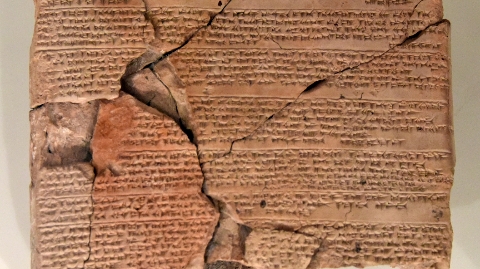
Artificial intelligence is now opening a new door to uncovering the secrets of ancient civilizations. The writings carved on clay tablets thousands of years ago were like complex puzzles for researchers for so long. A new AI technology is now helping them to read and understand them much faster. Recently, a group of researchers in Germany has developed an AI tool that can identify the handwriting of writers of the Hittite civilization from 3,500 years ago. This is being seen as a major breakthrough in the world of archaeology and linguistics.
Advertisement
The Hittites were a powerful civilization in ancient Anatolia. They had settlements and influence in a vast area of present-day Turkey about 3,500 years ago. They wrote down various information about administration, religious rituals, war, law, and daily life on clay tablets. These texts were created in a type of engraving method known as cuneiform. The marks were made by pressing on soft clay with a sharp stylus (writing tool). Later, the tablets dried and hardened.
Advertisement
The Hittite language was part of the Indo-European language family. It is also one of the oldest written languages in human history. However, the researchers’ biggest problem was elsewhere. Over the millennia, numerous tablets have broken. Their fragments are scattered in museums around the world. As a result, it has become extremely difficult to understand which broken parts belonged to which original document. The Hittites were settled and influenced in a vast area of present-day Turkey about 3,500 years ago. They wrote down various information about administration, religious rituals, laws, and daily life on clay tablets. A new AI system called Paleographicum has been created to simplify this complex task. Researchers from the University of Würzburg and the Mainz Academy of Sciences and Literature in Germany have created it.
Advertisement
The software can analyze cuneiform signs in digital images and identify subtle differences in the handwriting of different authors. At first glance, the cuneiform signs seem almost the same. But a little closer inspection reveals that each author had his own style of writing. Some people would draw the stylus slightly, creating a slight curve in the marks. Others would leave more space between the marks. Some would press deeper, some would press lighter. Just like modern handwriting, these small differences carry the identity of the writer.
Advertisement
Previously, it took researchers days to find similarities between one fragment of a tablet and another. Sometimes, it would take three days to compare five fragments. Now, AI can do the same job in a few minutes. According to the researchers, this technology will save thousands of work hours in the future. Currently, about 70,000 digital images are stored in the Paleographicum. These images contain more than 5 million cuneiform signs. AI searches the entire database and extracts similar or similar signs. Then, they are arranged side by side and presented to the researchers, so that it is easy to compare. If you pay close attention, you can see that each writer had his own style of writing.
Advertisement
Some would write with a slight pull of the stylus, which would create a slight curve in the signs. Others would leave more space between the signs. Technology plays a big role not only in speed, but also in determining time. Hittite tablets were usually not dated. As a result, determining which document belongs to which century has been a long-standing challenge. But human handwriting styles change over time. Paleographicum can analyze the patterns of those changes to estimate which writings are closer to which time. It is an example of a new trend in archaeology known as digital paleography. Paleography is the study of ancient handwriting. Until now, this work relied entirely on human eyes and experience. Now machine learning is taking that analysis to a much larger scale.
Advertisement
The project was led by a research initiative called Kuka, which ran from 2018 to 2023. The researchers later improved the software to be able to analyze a large number of images quickly. Now they are also trying to make the technology more effective with user feedback. The researchers’ next goal is even bigger. They want to create a system that can automatically identify different writers. If that’s possible, historians will be able to know what a particular writer wrote at different times in his life. Even who worked in the royal court, who wrote religious documents, or who created administrative documents—those things may gradually become clear. Paleography is the study of ancient handwriting. Until now, this work has relied entirely on the human eye and experience. Now machine learning is taking that analysis to a larger scale.
Advertisement
As a result, new insights will be gained not only about language, but also about the social structure of an entire civilization. Historians will then be able to understand more deeply the life, training, professional development, and internal relationships of the Hittite writing class. Artificial intelligence usually brings to mind images of future technology. But the interesting thing is, this technology is now helping to read the past in a new way. Dead languages, broken tablets, and the identities of lost writers from thousands of years ago are slowly becoming visible again through computer analysis. A large part of the history of human civilization is still hidden underground or in broken artifacts. AI may become one of the most important tools in archaeology in the future to shed light on that darkness.