

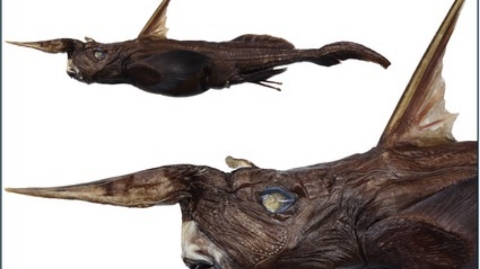
A groundbreaking marine discovery has officially put Costa Rica’s deep oceans in the spotlight. For the first time, scientists have confirmed and documented a new species of ghost shark named Rhinochimaera costaricana in the Pacific waters off the coast of Costa Rica.
Advertisement
Published in the scientific journal Zootaxa, the study underscores just how much of the region’s deep-sea biodiversity remains uncharted, even in areas heavily studied by regional researchers. The breakthrough was led by a collaborative effort between Costa Rica’s Fisheries and Aquaculture Institute (INCOPESCA), the University of Costa Rica (UCR), and Brazil’s Federal University of Pará.
Advertisement
What is a Ghost Shark?
Despite the spooky moniker, ghost sharks are not true sharks. They belong to a group known as long-nosed chimeras an ancient lineage of cartilaginous fish related to sharks and rays that has inhabited the deep ocean for hundreds of millions of years. They earned the name “ghost shark” due to their pale, ethereal coloring and elusive deep-sea habitats. Scientists identified R. costaricana using three male specimens collected between 2000 and 2023. These specimens were found thriving at extreme depths ranging from 390 to 787 meters (1,280 to 2,580 feet) far beyond the reach of human divers.
Advertisement
What Makes Rhinochimaera costaricana Unique?
To officially classify the new species, researchers compared 49 distinct body measurements from the Costa Rican specimens against data from over 90 individuals belonging to the three previously known Rhinochimaera species. According to lead author Naidely Valeria Vidaurre-Quesada and the research team, R. costaricana stands out due to several distinct morphological and genetic traits:
Advertisement
- Shorter Snout: A noticeably reduced snout length compared to its closest relatives.
- Pronounced Dorsal Fin: A taller first dorsal fin and spine.
- Wider Fin Gap: A larger structural gap separating the two dorsal fins.
- Fewer Tail Tubercles: A reduced number of small, bony structures along its caudal (tail) region.
The Genetic Proof
Advanced genetic sequencing sealed the case. DNA analysis revealed a 3.9% to 4.7% genetic divergence from other known Rhinochimaera species. In marine biology, this variation is well above the threshold required to officially declare a completely new species.
Advertisement
Why This Deep-Sea Discovery Matters
The naming of Rhinochimaera costaricana directly honors the Central American nation where all known specimens were found. However, the discovery also serves as a stark warning. Marine biologists emphasize that the deep Pacific waters beyond Costa Rica’s continental shelf remain some of the least explored ecosystems on Earth. As commercial fishing pressures increase and climate change continues to alter ocean temperatures, scientists fear that many deep-sea species may be going extinct before humanity ever documents them. “The deep Pacific off Costa Rica likely holds many more undocumented species. Continued exploration paired with cutting-edge genetic tools is absolutely essential if we want to understand and protect these fragile ecosystems.”
Advertisement
What’s Next for Deep-Sea Research?
The confirmation of R. costaricana marks a major turning point for regional marine conservation. By utilizing modern genetic tools alongside traditional taxonomy, scientists can now accurately re-examine species that may have been misclassified for decades, reshaping future marine conservation priorities in the Pacific Ocean.