

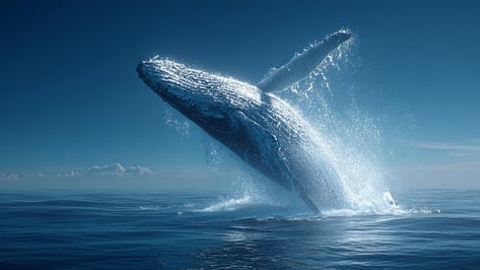
Modern science and artificial intelligence are bringing humanity face to face with a reality that once seemed impossible. For decades, whales were viewed as emotional but relatively simple marine animals. Recent research, however, has dramatically changed that perception. Scientists now believe whales do far more than sing. They communicate through highly structured sound systems that may contain elements similar to language, including recurring patterns, regional dialects, and socially transmitted knowledge. This discovery is challenging long-held assumptions about intelligence, culture, and communication in the animal kingdom.
Ads
Earlier theories suggested that whale sounds were mainly used for navigation and hunting. Researchers involved in Project CETI have analyzed thousands of whale vocalizations, known as codas, and uncovered evidence of remarkably organized communication patterns. These vocal signals appear to contain structured sequences, recurring sound combinations, and variations that differ between whale populations living in different regions of the ocean.
Ads
Scientists have also observed patterns that resemble some features found in human language. Small sound units appear to be combined into larger, meaningful sequences following specific rules. The existence of regional dialects and learned communication behaviors suggests that whales possess distinct cultural traditions that are passed from one generation to another.
Ads
Project CETI is one of the world’s most ambitious scientific initiatives. It brings together computer scientists, linguists, marine biologists, and robotics experts from leading institutions, including Massachusetts Institute of Technology, Harvard University, and National Geographic Society. Using hydrophone arrays, advanced sensors, and artificial intelligence, researchers are attempting to identify the underlying structure of whale communication and eventually decode its meaning. Success could transform our understanding of consciousness, intelligence, and humanity’s place within Earth’s ecosystem.
Ads
If scientists can successfully interpret whale communication, the achievement could revolutionize interactions between humans and other species. It would also raise important ethical questions about how we treat intelligent animals that may possess complex social lives, cultural traditions, and sophisticated methods of sharing information. Recent studies further suggest that whales may be highly aware of human activities. Their extraordinary hearing allows them to detect sounds from hundreds of kilometers away. Ships, submarines, sonar systems, and other human-generated noises constantly enter their environment, making it likely that whales are aware of our presence and activities on a large scale.
Ads
Whales are also extremely sensitive to changes in ocean temperature, water currents, and chemical conditions. As a result, they can directly experience the effects of pollution, industrial activity, and environmental degradation. If human actions become a topic within whale communication networks, it may represent an adaptive response to environmental threats rather than a coincidence. Marine biology and animal behavior research increasingly indicate that whales maintain complex social structures and transfer knowledge across generations. Through collective learning, whale communities can share information about migration routes, food sources, environmental dangers, and potentially even areas affected by human activity. This cultural transmission enables whale populations to adapt and respond to changing conditions over time.
Ads
Unlike humans, who primarily rely on vision and technology to interpret the world, whales experience their environment through sound. They analyze acoustic signals and subtle environmental changes to build an understanding of their surroundings. Although they may not comprehend human technology in the same way we do, they can perceive its consequences and adjust their behavior accordingly. This has led scientists to explore a fascinating question: Are whales consciously aware of humanity’s impact on the oceans? Current evidence suggests that whales can recognize and respond to many human-generated changes in their environment.
Ads
Their perception differs from ours, but it may be equally effective within the vast underwater world they inhabit. The growing body of research on whale communication challenges the traditional human-centered view of intelligence. Rather than being passive inhabitants of the ocean, whales may represent a sophisticated society with its own culture, communication systems, and collective knowledge. Decoding their language could reshape how we define consciousness and intelligence while reminding us that humanity is not the only species capable of complex social and cultural behavior. As scientists continue to unlock the secrets of whale communication, one message becomes increasingly clear: Earth is shared with other forms of intelligence that perceive, learn from, and respond to the world in ways we are only beginning to understand.