

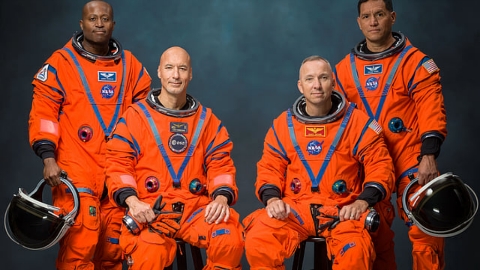
NASA has officially revealed the four astronauts selected for the Artemis 3 mission, a crucial training flight designed to prepare for humanity’s return to the Moon. The crew was announced on June 9 and will take part in one of the most complex missions ever planned by NASA. The Artemis 3 crew includes Commander Randy Bresnik, Pilot Luca Parmitano, Mission Specialist Frank Rubio, and Mission Specialist Andre Douglas.
Ads
Together, they will conduct an extensive orbital rehearsal that will help validate the systems needed for future lunar landings.Commander Randy Bresnik, a former U.S. Marine Corps officer, will lead the mission. He has previously flown to space twice and spent a total of 149 days beyond Earth. His experience makes him one of NASA’s most seasoned astronauts. Pilot Luca Parmitano represents the European Space Agency. The Italian astronaut has also completed two space missions. He is widely known for surviving a dangerous spacewalk incident when water unexpectedly filled his helmet, creating a life-threatening situation.
Ads
Mission Specialist Frank Rubio is a former U.S. Army officer, family physician, and flight surgeon. He holds the record for the longest single spaceflight by an American astronaut after spending 371 consecutive days aboard the International Space Station due to delays in his return mission.Mission Specialist Andre Douglas will be making his first trip to space. Selected as a NASA astronaut in 2021, Douglas is an engineer with a doctoral degree from George Washington University and previously served as a backup crew member for Artemis 2. Although Artemis 3 was originally planned as a lunar landing mission, NASA has revised its objectives.
Ads
The mission will now remain in Earth orbit and serve as a large-scale test flight for technologies required in future Moon missions. Its primary goal is to demonstrate successful docking operations between NASA’s Orion spacecraft and lunar landers developed by private companies. The mission will begin with the launch of Blue Origin’s Blue Moon lander, which can remain in orbit for up to 90 days without a crew. The four astronauts will then launch aboard NASA’s Orion spacecraft using the powerful Space Launch System (SLS) rocket from Kennedy Space Center in Florida. Once in orbit, Orion will rendezvous and dock with the Blue Moon lander.
Ads
The astronauts will spend two days connected to the vehicle, entering it to inspect its life-support and control systems. After completing these tests, SpaceX will launch its Starship lunar lander into orbit. The crew will then dock Orion with Starship and spend approximately one day evaluating its systems. Following the completion of all mission objectives, Orion and its crew will return to Earth and splash down in the Pacific Ocean off the coast of California.
Ads
NASA considers this mission a critical step toward returning humans to the lunar surface. If all systems perform successfully, Artemis 4 is expected to become the mission that places astronauts on the Moon for the first time since 1972.Despite recent challenges, including damage to Blue Origin’s launch infrastructure during a rocket test, NASA remains confident that the required hardware will be ready on schedule. SpaceX is also continuing development and testing of its Starship lander to support future Artemis operations.
Ads
As preparations intensify, NASA views Artemis 3 as the bridge between testing and exploration. The mission will help ensure that the technologies, procedures, and spacecraft needed for future Moon landings are fully operational before astronauts once again set foot on the lunar surface.