

Humans originated, scientists believe, the earliest primates were small and nocturnal animals that looked like cheetahs. The development of primates began with the origin of such animals. Scientists have divided the evolved lineages into two suborders: 1. Strepsirrhini and 2. Haplorrhini, the members of these two suborders are called New World monkeys and Old World monkeys respectively. The Haplorrhini suborder consists of four tribes. The tribe to which humans belong is called Haplorrhini. Gorillas, chimpanzees, orangutans and humans are hominids.
Humans have a well-structured brain and the largest (1300-1450 cubic centimeters) in the animal kingdom, and the cerebral hemispheres are well-developed.
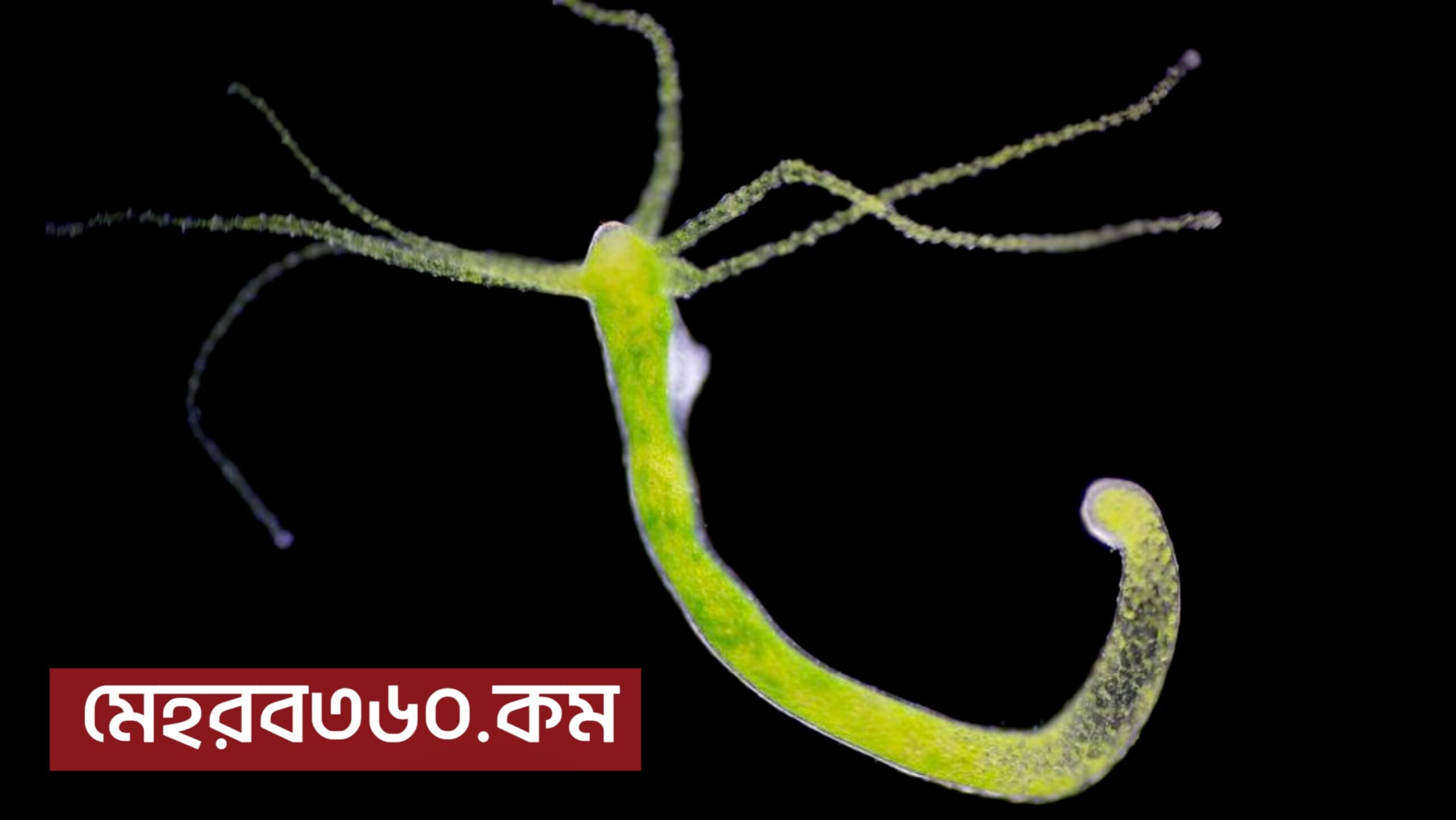
Now, there is no such thing as a brain for intelligence or thinking! Hydra, jellyfish, sea anemones, starfish do not have a brain. These are animals belonging to the Cnidaria class. But they can catch prey, understand their surroundings, and avoid danger. So what? Can brainless animals think?
Hydra
According to scientists, neurons can be present even without a brain. Except for sea sponges and placozoans, almost all animals have neurons, that is, all animals except the peripheral stage can have neurons. Jellyfish or sea anemones have a network of nerves spread throughout their bodies. This network of nerves detects their sensations and responds to them throughout the body based on that. Swimming, contracting, hunting, etc. In other words, they can process information without a brain.
Even with this simple nervous system, they perform surprisingly complex tasks. Scientists have tested and found that an animal called the starlet sea anemone can form a memory. This means that it learns to establish a relationship between two separate events. For example, if you pair a mild electric shock with an innocent flash of light, it will shrink when it sees only the light without the shock.
Another experiment showed that sea anemones can recognize their genetically identical neighbors after repeated encounters and reduce their natural aggressive behavior towards them. This proves that they can distinguish between themselves and others. The study found that box jellyfish can understand the relationship between visual cues and physical sensations when they touch objects, which helps them avoid obstacles.
Animals that don’t have brains but have nerves think the way they do
The definition of thinking or thinking depends on which field you look at it from. Psychologists, biologists, and neuroscientists each define thinking differently. Scientists generally don’t like to use the word thinking, but prefer the term cognition or cognitive process. When we think, we usually think of something going on in our heads, but we can’t say for sure whether it exists in other animals.
There is no single definition of cognition either. However, in the broadest sense, cognition is the process of processing information from the outside world and from inside the body and doing something. If thinking is taken in this sense, then it can be said that all organisms think in some way. Even those that do not have neurons, such as marine sponges in the Peripheral phylum, survive by processing information about the environment.
However, there is still doubt about more advanced cognitive processes (advanced cognition) beyond basic learning. Any change in behavior beyond reflexes or involuntary reactions can be considered a basic cognitive process. In that sense, brainless animals also display cognitive abilities. However, more advanced cognitive abilities may require consciousness or self-awareness.
Jellyfish, a group of sea anemones belonging to the phylum Cnidaria, have survived for more than seven hundred million years. Many animals with brains have become extinct, but they still survive successfully today.
This tolerance proves that even without a brain, they have a unique adaptive system that has helped them survive and thrive in extreme environments over geological time. Their neurons are able to sense and interpret the environment. This may be an early form of thought.