

When winter sets in, people in rural areas tend to feel its intensity more than city dwellers, mainly because villages are more open and remain in closer contact with nature. In many countries, winter brings snowfall, but Bangladesh experiences cold weather without snow. This raises a natural question: what exactly is snowfall, and is it ever possible in Bangladesh?
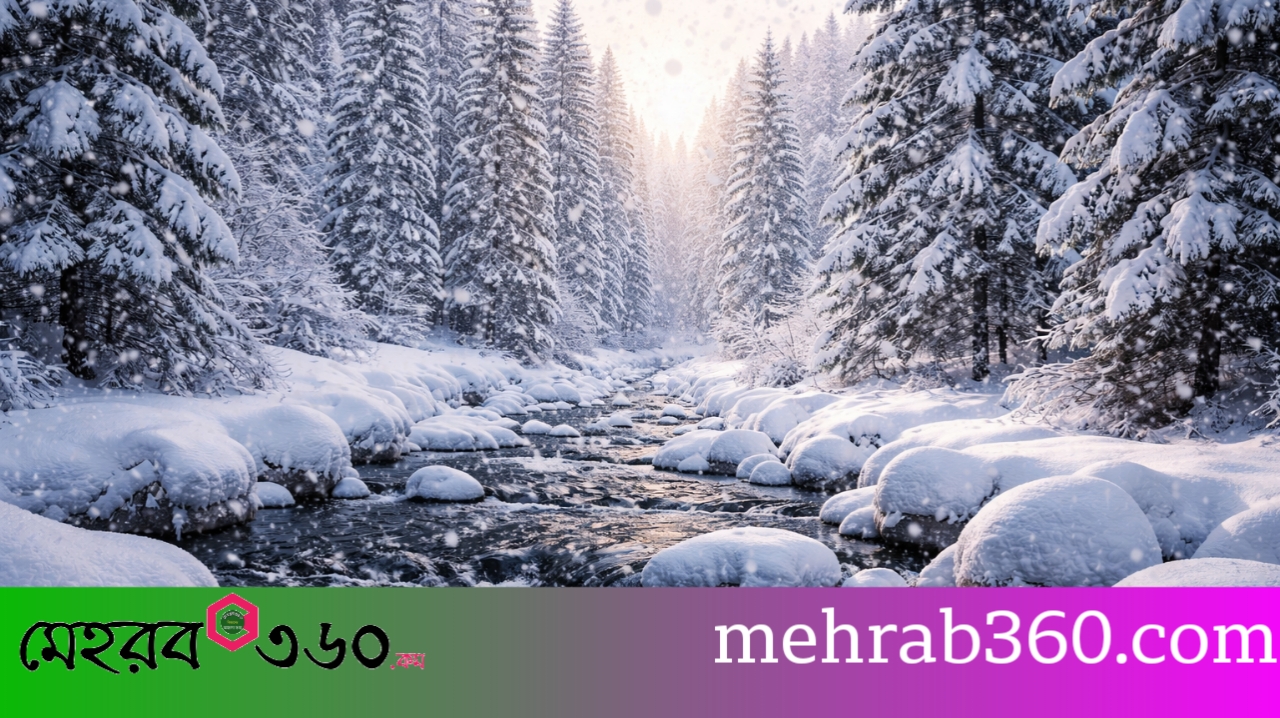
Winter and the Feeling of Cold in Bangladesh
To understand why snowfall does not occur here, we must first understand what snowfall is. As most informed readers know, the Sun’s heat causes water from seas, rivers, canals, wetlands, and ponds to evaporate and rise upward. One key reason for this upward movement is that water vapor is lighter than air. As it rises higher into the atmosphere, the temperature gradually decreases. However, this upward journey has a limit.
What Is Snowfall?
At about 11 kilometers above the Earth’s surface, in the troposphere, the air’s capacity to hold water vapor decreases significantly. There, water vapor combines with dust particles, becomes heavier, and can turn into ice crystals. If the temperature drops further, these ice particles may fall toward the Earth as snow.
Evaporation and the Rise of Water Vapor
But snowfall does not occur in Bangladesh because a crucial condition is not met. For snow to reach the ground without melting, the surface temperature must be at or below the freezing point, that is, below 0°C. In Bangladesh’s recorded history, the lowest temperature was 2.6°C, measured in Tetulia in 2018. This is still above the freezing point.
As a result, even if snow crystals form high in the sky, they melt while falling through Bangladesh’s relatively warm lower atmosphere, where temperatures are usually above 20°C. By the time they reach the ground, they turn into rain instead of snow. This is why Bangladesh experiences rainfall rather than snowfall. However, hailstorms do occur occasionally, as hail forms under different atmospheric conditions.
Since the independence of Bangladesh, no snowfall has ever been officially recorded, because temperatures have never dropped below 0°C. The condition for the future remains the same: snowfall would only be possible if temperatures fall below the freezing point. Some researchers speculate that due to climate change, light snowfall might occur in parts of Panchagarh around 2030, but it would certainly not resemble the heavy snowfall seen in regions like Siberia.
Temperature as the Key Factor
Snowflakes formed in the sky do not recognize borders such as Bangladesh or Siberia. They can form anywhere. Whether they reach the ground as snow or melt into rain depends entirely on temperature. In short, for snowfall to occur in any country, the temperature must fall below freezing. Even in peak winter, Bangladesh’s temperature has never reached that threshold.