

 |
| Wikipedia |
The Prince of Mathematics, Carl Friedrich Gauss, and His Royal Kingdom of Numbers
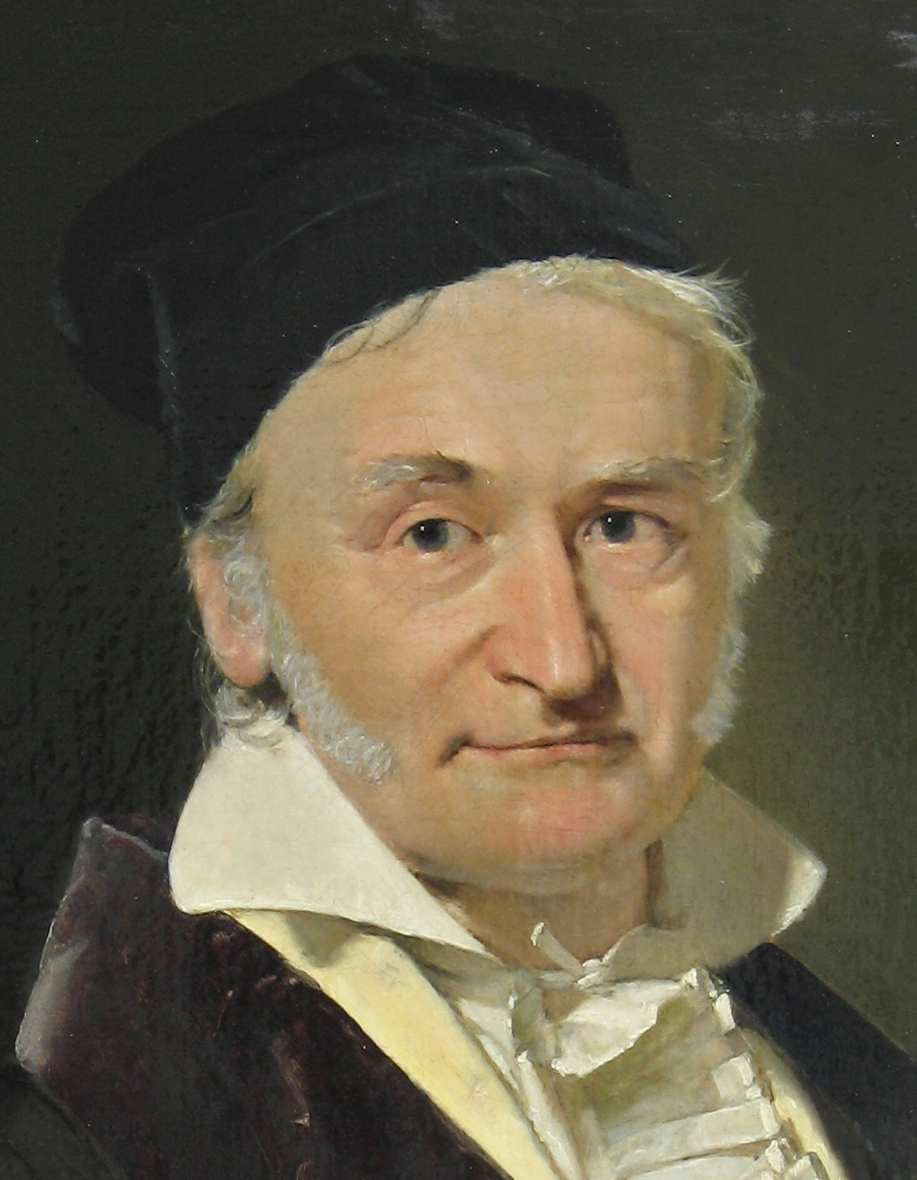
On February 23, 1855, in the quiet German city of Göttingen, an elderly man breathed his last at the age of 78. Over the course of his long life, he gifted humanity mathematical insights so profound that they continue to illuminate the worlds of science and technology today. Scholars lovingly call him the “Prince of Mathematicians.” His name was Carl Friedrich Gauss. On this anniversary of his passing, let us look back at the extraordinary life of this legendary figure.
{inAds}
Gauss was born on April 30, 1777, in the city of Braunschweig, into a poor working-class family. Stories of his genius sound almost mythical. It is said that at just three years old, he corrected an error in his father’s bookkeeping. But the most famous story dates from when he was eight years old. One day, his primary school teacher assigned the class a tedious task: add all the numbers from 1 to 100. The teacher expected this would keep the students busy for a long time. Yet within seconds, young Gauss placed his slate on the desk. The teacher ignored him at first. But when all the students eventually submitted their answers, only Gauss’s was correct.
How did he do it so quickly? Instead of adding sequentially, he noticed a hidden pattern. The first and last numbers added to 101. So did the second and second-last: 2 + 99 = 101. This pairing continued, forming exactly 50 pairs of 101. He simply multiplied 50 × 101 and obtained the answer: 5050. This elegant insight remains one of the most famous classroom examples of mathematical creativity.
{inAds}
In 1791, at age 14, Gauss’s extraordinary talent came to the attention of the Duke of Brunswick, who sponsored his education at the Brunswick University of Technology. Later, he studied at the prestigious University of Göttingen from 1795 to 1798. Although he left without a formal degree at that time, he completed one of the greatest mathematical works ever written: Disquisitiones Arithmeticae.
This masterpiece, published in 1801, laid the foundations of modern number theory. In it, Gauss introduced modular arithmetic, explored quadratic residues, and unified arithmetic, algebra, and geometry. One of his remarkable achievements was proving that a regular 17-sided polygon can be constructed using only a ruler and compass. This discovery was so meaningful to him that he wished a 17-gon engraved on his tombstone. Ironically, the mason declined, saying it looked too much like a circle.
{inAds}
Gauss later earned his doctorate from Helmstedt University in 1799. He turned his attention to astronomy and helped establish an observatory in Göttingen. In 1801, the Italian astronomer Giuseppe Piazzi discovered the dwarf planet Ceres but soon lost track of it. Using his own mathematical methods, Gauss predicted its exact position, allowing astronomers to rediscover it. This achievement demonstrated the astonishing predictive power of mathematics.
Despite personal tragedies, including the deaths of his wife and children, Gauss continued his research. In 1809, he published a major work on celestial mechanics, describing planetary motion using differential equations and conic sections. His mind remained a forge where numbers were shaped into tools capable of mapping the heavens.
{inAds}
One of Gauss’s most beautiful discoveries was his “Eureka Theorem,” in which he proved that every positive integer can be expressed as the sum of at most three triangular numbers. He also provided the first complete proof of the Fundamental Theorem of Algebra, showing that every polynomial equation has at least one root, real or complex. He developed the modern interpretation of complex numbers in the form a + bi and gave them geometric meaning on the coordinate plane.
In 1816, the Paris Academy of Sciences offered a prize for proving Fermat’s Last Theorem. Although many encouraged Gauss to attempt it, he declined, remarking that he could create countless unprovable theorems himself. The theorem was finally proven in 1995 by Andrew Wiles, nearly 358 years after its proposal.
{inAds}
Gauss’s curiosity extended beyond pure mathematics. In 1833, he collaborated with physicist Wilhelm Weber to build the world’s first electromagnetic telegraph. Encouraged by Alexander von Humboldt, he also conducted groundbreaking studies of Earth’s magnetic field, improving measurement techniques with remarkable precision.
Although he disliked teaching, Gauss occasionally gave lectures on probability and astronomy. He preferred Latin as the universal language of science, seeing it as a bridge connecting scholars across nations and centuries.
Political turmoil forced Weber to leave Göttingen in 1837, and Gauss’s research slowed in later years. Still, he remained a guiding star for other scientists. He had explored non-Euclidean geometry long before others but hesitated to publish his findings, fearing criticism. After his death, his brain was preserved and studied, reflecting the enduring fascination with the mind behind such brilliance.
{inAds}
On February 23, 1855, Gauss passed away in Göttingen and was buried in the Albani Cemetery. His legacy lives on in every equation, algorithm, and scientific model shaped by his insights. His famous words remain a fitting farewell:
“Mathematics is the queen of the sciences, and arithmetic is the queen of mathematics.”
In Gauss’s hands, numbers were not merely symbols. They were instruments of discovery, keys that unlocked the hidden architecture of the universe. His kingdom was invisible yet eternal, built not of stone, but of logic, beauty, and truth.