

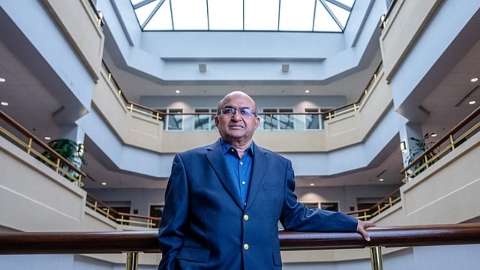
A groundbreaking healthcare technology developed by Bangladeshi-origin scientist Dr. Sheikh Iqbal Ahmed could soon allow people to perform important blood-related health checks using only a smartphone. Instead of drawing blood with a syringe, users may simply place their fingertip in front of a smartphone camera to measure key health indicators.
Dr. Ahmed, a professor of Computer Science at Marquette University in the United States and a graduate of Bangladesh University of Engineering and Technology (BUET), is leading research to transform smartphones into personal healthcare devices. His long-term goal is to make medical testing easier, faster, more affordable, and completely needle-free. His research team has developed a patented technology called UBWhite. The system uses a smartphone camera fitted with a blue-light filter, an LED flashlight, and a small magnet to analyze blood flow in the tiny blood vessels of the fingertip. Artificial intelligence then examines the recorded video frame by frame to estimate the number of white blood cells without drawing blood.
White blood cell counts are essential for diagnosing conditions such as leukemia, lymphoma, and serious infections. The team’s research has already been published in respected scientific journals, including Nature Scientific Reports and IEEE publications. According to Stanford University and Elsevier’s global ranking, Dr. Sheikh Iqbal Ahmed is among the world’s top 2% most influential scientists. His research combines artificial intelligence, image processing, and software engineering to develop painless and accessible healthcare solutions.
Initial clinical testing involving 20 patients showed that UBWhite produced results very close to those of conventional laboratory blood tests. A larger study involving 200 patients is currently underway in collaboration with the Georgia Cancer Center, while additional research is also being conducted with researchers in Bangladesh. The research team is not stopping at white blood cell measurement. They are also developing smartphone-based technologies capable of estimating blood glucose, hemoglobin, creatinine, blood pressure, and heart rate using similar AI-powered video analysis. These technologies, however, are still in the research and development stage.
The project aims to reduce healthcare costs while making routine health monitoring available from home. In the United States alone, more than one billion Complete Blood Count (CBC) tests are performed every year, each costing around $30 on average. A successful smartphone-based alternative could significantly lower costs and improve access to healthcare, especially in remote and underserved areas. To commercialize the technology, Dr. Ahmed founded UBVital, a healthcare startup that has already secured $250,000 in seed funding and earned a place in the Harvard Business School Foundry Bootcamp.
Researchers emphasize that UBWhite is not intended to replace laboratory blood tests at this stage. Instead, it is designed to serve as a convenient, low-cost, and needle-free tool for routine health monitoring. If future clinical trials confirm its effectiveness, the technology could transform how millions of people monitor their health using nothing more than a smartphone.
Source: Marquette Today