
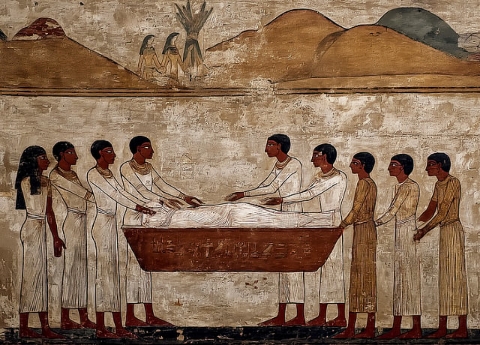
Ancient Egyptian Mummy Secrets Revealed by Medical Scans. Thousands of years ago in ancient Egypt, when a person died, their body was preserved through a complex process, where internal organs were removed, the body was treated with special salts, dried for days, and wrapped carefully in linen to create a mummy. These mummies have always fascinated scientists, but studying them once carried serious risks, because unwrapping the layers could easily destroy their fragile ancient structure, and many were permanently damaged this way.
However, modern science has changed the game completely. Now, advanced medical imaging allows researchers to uncover hidden secrets without touching a single thread.In Budapest, Hungary, the Semmelweis Museum of Medical History, established in 1965, houses several ancient Egyptian mummies. Scientists long wanted to examine what lay inside them, and now they are doing so using high-resolution CT scanning technology. According to radiologist Ibolka Dudás from Semmelweis University, the goal is to obtain extremely precise images of the internal structures, to detect abnormalities, and understand the exact preservation techniques used thousands of years ago.CT scanning, or computed tomography, is a revolutionary advancement in medical science.
Essentially, it is an advanced form of X-ray, that uses rotating beams and computer processing to generate detailed 2D and 3D images of internal structures. Beyond human medicine, it is now used to study fossils, tiny insect brains, and even meteorites from Mars, without causing any damage, while revealing crystal-clear internal details. Dudás and her team are using next-generation CT scanners equipped with photon-counting detectors, providing far sharper images than ever before.
According to museum curator Krisztina Sheffer, earlier studies were conducted on these mummies, but the new scans are significantly clearer, raising hopes for groundbreaking discoveries. Six of the museum’s mummies have already undergone carbon dating, with the oldest dating back about 2,400 years, though Egyptians began mummification practices thousands of years earlier.
Analysis of scan data is ongoing, but previous mummy scanning projects worldwide have already revealed fascinating insights. Ancient Egyptians believed in the afterlife, so embalmers often placed valuable items, coins, and magical amulets within the linen wrappings, and scans have clearly revealed these objects. Additionally, scans have uncovered health conditions such as arthritis, and studies suggest high rates of anemia among ancient Egyptian children. Remarkably, CT scans have even detected signs of cancer in ancient remains, and in one case, scans of South American mummies uncovered evidence of a violent massacre. Even the famous Pharaoh Tutankhamun’s mummy was scanned, revealing that malaria and a broken leg were likely causes of his death.
Preliminary findings from the Semmelweis Museum mummies suggest that preservation techniques themselves may help determine their age. One particularly surprising discovery involved a sealed package that gave no clue about its contents. Researchers initially thought it might contain a bird, or even a severed human head, but CT scanning revealed it was actually a mummified human leg. Another scan showed a person who suffered from severe bone degeneration. Scientists hope that continued analysis will unlock even more secrets about ancient lives and mummification methods.Modern imaging technology has opened an entirely new chapter in mummy research, allowing scientists to explore ancient remains without causing harm, and as this technology advances, the silent stories hidden within Egypt’s mummies may soon unfold in ways no one ever imagined.