

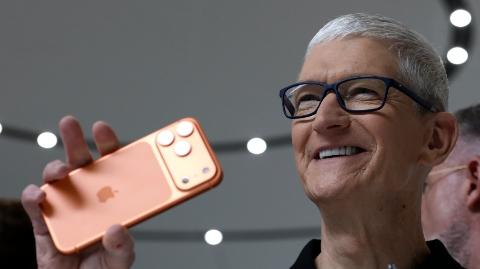
Apple issued a stronger-than-expected revenue forecast for the current period after surpassing sales and earnings estimates in its fiscal second quarter, sending shares up about 3% in extended trading; despite the overall beat, iPhone revenue missed expectations for the second time in three quarters, making it the only major metric to fall short in Thursday’s report.
According to LSEG consensus estimates, earnings per share came in at $2.01 versus $1.95 expected, while total revenue reached $111.18 billion compared to $109.66 billion forecast; iPhone revenue totaled $56.99 billion against expectations of $57.21 billion, Mac revenue came in at $8.4 billion versus $8.02 billion expected, iPad revenue reached $6.91 billion compared to $6.66 billion, wearables, home and accessories generated $7.9 billion versus $7.7 billion, services revenue hit $30.98 billion against $30.39 billion estimates, and gross margin stood at 49.3% compared to 48.4% expected.
Revenue rose 17% year over year from $95.4 billion, marking the company’s first earnings report since the announcement that CEO Tim Cook will step down after 15 years; the company projected June quarter revenue growth between 14% and 17%, far exceeding analysts’ expectations of 9.5% growth to $103 billion, while also authorizing an additional $100 billion in share buybacks and increasing its dividend by 4% to 27 cents per share.
iPhone sales climbed 22% year over year, driven by strong demand, although supply chain constraints persisted due to a global memory shortage fueled by rising artificial intelligence demand; Cook noted that the iPhone 17 lineup is now the most popular in the company’s history, and CFO Kevan Parekh confirmed ongoing supply limitations affecting both iPhones and Macs.
Cook warned that memory costs are expected to rise significantly in the current quarter and could increasingly impact the business, prompting Apple to explore various strategies to manage the pressure; he added that the impact was minimal in the December quarter but more noticeable in the March period.
In March, Apple introduced several new products, including the iPhone 17e, a refreshed iPad Air with an M4 chip in 11-inch and 13-inch variants, and the MacBook Neo, a budget-friendly $599 laptop targeting students and cost-conscious consumers.
Leadership transition remains a key focus for investors, as John Ternus is set to succeed Cook, who will become executive chairman on September 1; Ternus, a longtime Apple executive overseeing hardware, joined the earnings call and expressed confidence in the company’s future, highlighting an ambitious product and services roadmap.
On artificial intelligence strategy, Apple recently partnered with Google to integrate its Gemini AI model into Siri, with Cook stating that the collaboration is progressing well while the company continues to develop its own AI capabilities independently.
Services revenue grew approximately 16% year over year, supported by Apple’s ecosystem of more than 2.5 billion active devices, enabling expansion in subscriptions, Apple Pay, iCloud and AppleCare; this segment continues to drive higher margins, with overall gross margin rising to 49.3% from 48.2% in the previous quarter.
Sales in Greater China increased 28% year over year to $20.5 billion, reinforcing its position as Apple’s third-largest market after the Americas and Europe, while research and development expenses surged 33% to $11.42 billion, reflecting increased investment in innovation and artificial intelligence, which both Cook and Parekh identified as a critical long-term growth area.
Source: www.cnbc.com