
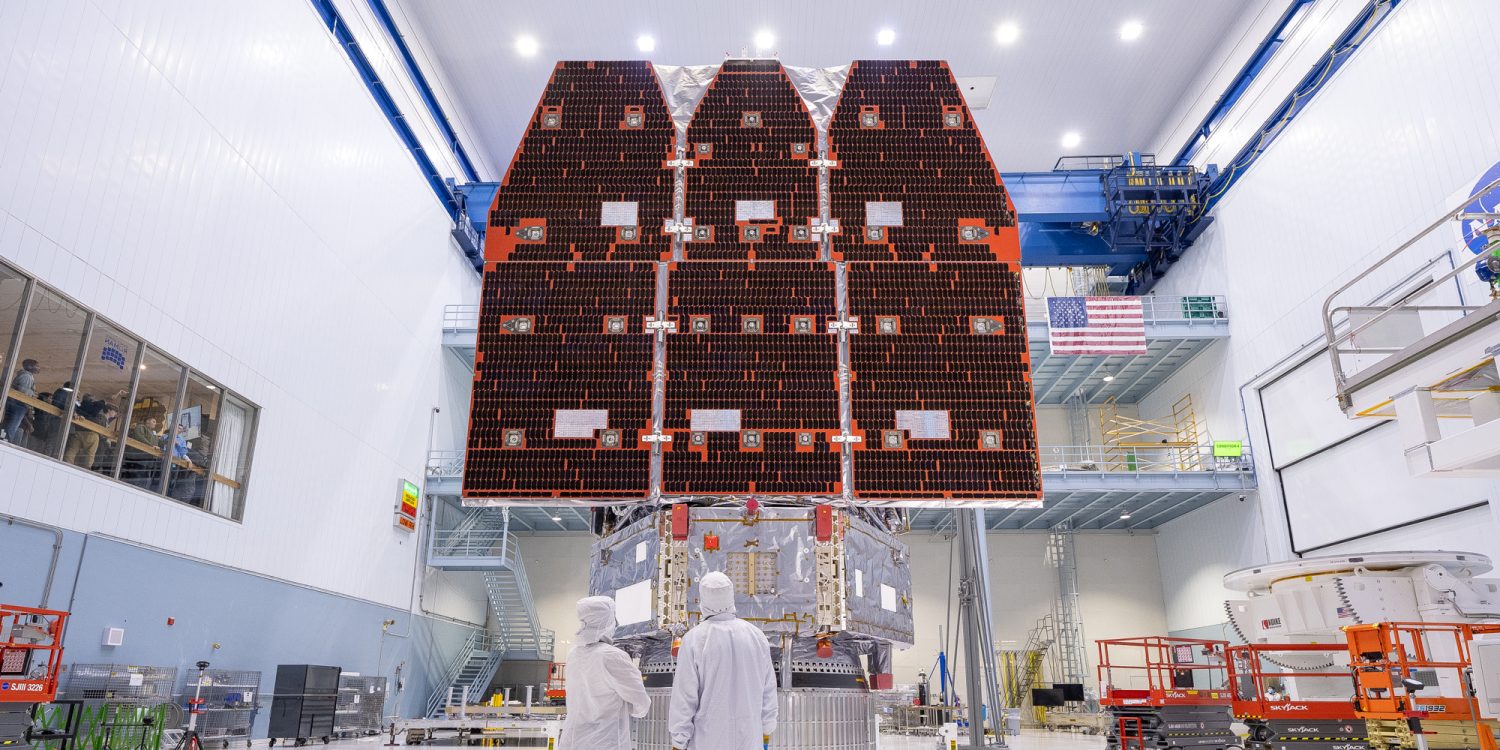
As NASA moves deeper into a new era of space-based astronomy, another flagship observatory is quietly approaching the launch pad: the Nancy Grace Roman Space Telescope, designed to survey the universe at a scale no previous space telescope has achieved, has completed assembly and is undergoing final environmental testing before shipment to Kennedy Space Center in Florida for a planned liftoff as soon as late 2026;
 |
| from NASA |
The Roman Space Telescope stands as NASA’s next major astrophysics observatory following the Hubble Space Telescope and the James Webb Space Telescope, originating as the Wide-Field Infrared Survey Telescope, a mission prioritized in the 2010 Decadal Survey to advance cosmology and exoplanet science, and later renamed in honor of Nancy Grace Roman, NASA’s first chief of astronomy whose leadership laid the foundation for space-based observatories that culminated in Hubble’s launch in 1990;
Unlike Webb, which focuses on ultra-deep infrared observations of specific cosmic regions, Roman is built for wide-field survey science, using a 2.4-meter primary mirror comparable in size to Hubble’s and feeding the Wide Field Instrument, capable of delivering Hubble-level angular resolution across a field of view about 100 times larger, enabling Roman to observe enormous portions of the sky and produce statistical datasets on a scale never before possible;
One of its primary scientific missions is to investigate dark energy, the mysterious force accelerating the expansion of the universe, by conducting precise measurements of weak gravitational lensing, subtle distortions in distant galaxy shapes caused by intervening dark matter, while also mapping galaxy clustering across cosmic time to refine cosmological models and deepen understanding of how cosmic structure evolved;
Roman will also conduct an extensive exoplanet microlensing survey toward the galactic bulge, using gravitational microlensing, where a foreground star briefly magnifies a background star’s light and reveals orbiting planets, a method especially sensitive to cold, Earth-mass planets in wide orbits and even rogue planets drifting freely through space, with NASA projecting the discovery of thousands of new exoplanets, filling gaps left by transit surveys such as the Kepler Space Telescope and the Transiting Exoplanet Survey Satellite;
The telescope also carries a technology-demonstration coronagraph instrument designed to suppress overwhelming starlight and directly image faint circumstellar environments, a crucial stepping stone toward future missions capable of directly imaging Earth-like planets in habitable zones; NASA has contracted SpaceX to launch Roman aboard a Falcon Heavy rocket, with liftoff targeted for late 2026 and extending into early 2027, after which Roman will travel to the Sun–Earth L2 Lagrange point approximately 1.5 million kilometers from Earth, the same gravitationally balanced region where Webb operates;
If schedules remain on track, Roman will soon begin delivering sweeping survey data that complements Webb’s deep, focused observations, not replacing existing observatories but expanding the cosmic census, transforming scattered snapshots into a vast panoramic atlas of the universe that could redefine cosmology and exoplanet science for decades to come.