
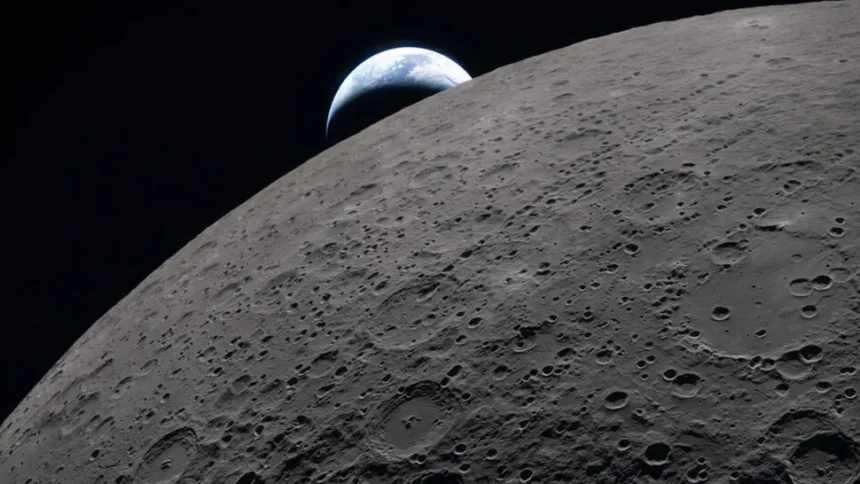
NASA’s Artemis 2 astronauts witnessed mysterious flashes of light on the far side of the moon, a phenomenon cameras often fail to capture clearly. These brief bursts, known as impact flashes, occur when meteoroids slam into the lunar surface and instantly vaporize, creating flickers of light across the moon’s cratered terrain. Scientists are especially excited because these observations could reveal valuable clues about how frequently the moon is struck by space rocks and how those impacts shape its surface and interior.
The Artemis 2 mission, humanity’s first crewed lunar journey since the historic Apollo 17 Moon Landing, launched from Florida Space Coast on April 1 and traveled around the moon’s far side on April 6. During the flyby, the four astronauts carefully monitored the dark lunar landscape, successfully spotting several impact flashes that appeared like tiny cosmic sparks in the darkness.
At the same time, citizen scientists on Earth were also searching for lunar impact flashes through NASA’s newly launched Impact Flash citizen science project. The initiative operates under the Geophysical Exploration of the Dynamics and Evolution of the Solar System, known as GEODES, which is part of NASA’s Solar System Exploration Research Virtual Institute. Although Earth-based observers likely did not witness the exact same impacts as the astronauts, their combined observations are helping researchers gather more precise data about the brightness, timing, and location of lunar impacts during current and future Artemis missions.
Scientists say these flashes are extremely important because they help reveal how often objects of different sizes collide with the moon, what kinds of craters they create, and how shock waves move through the moon’s interior. When combined with data from the moon-orbiting Lunar Reconnaissance Orbiter and future lunar instruments, these observations could provide critical information about the origin and behavior of meteoroids striking the moon.
Researchers from Johns Hopkins University recently explained that observing impact flashes both from Earth and from spacecraft near the moon allows scientists to measure these events far more accurately than using either method alone. Their findings suggest that coordinated observations can improve understanding of lunar impact hazards, which is especially important as NASA prepares for long-term human exploration.
This research also plays a major role in planning the future Artemis Base Camp near the moon’s south pole. Scientists studying lunar safety hazards found that the south pole naturally experiences fewer dangerous impacts than regions closer to the moon’s equator, making it a safer location for a permanent human outpost. They also concluded that modern shielding technology can reduce micrometeoroid threats by nearly 100,000 times, lowering the danger to manageable levels for future habitats.
Tracking impact flashes was only one part of the Artemis 2 mission’s scientific achievements. The crew gathered a massive collection of scientific data using 31 cameras aboard the Orion capsule named “Integrity.” NASA’s Artemis 2 Lunar Science Team is now analyzing and archiving the mission’s observations, including imagery of Earth and the moon, audio recordings, and astronaut commentary. According to NASA, all of this material will become publicly available within six months, giving scientists around the world a treasure chest of lunar research to explore.