

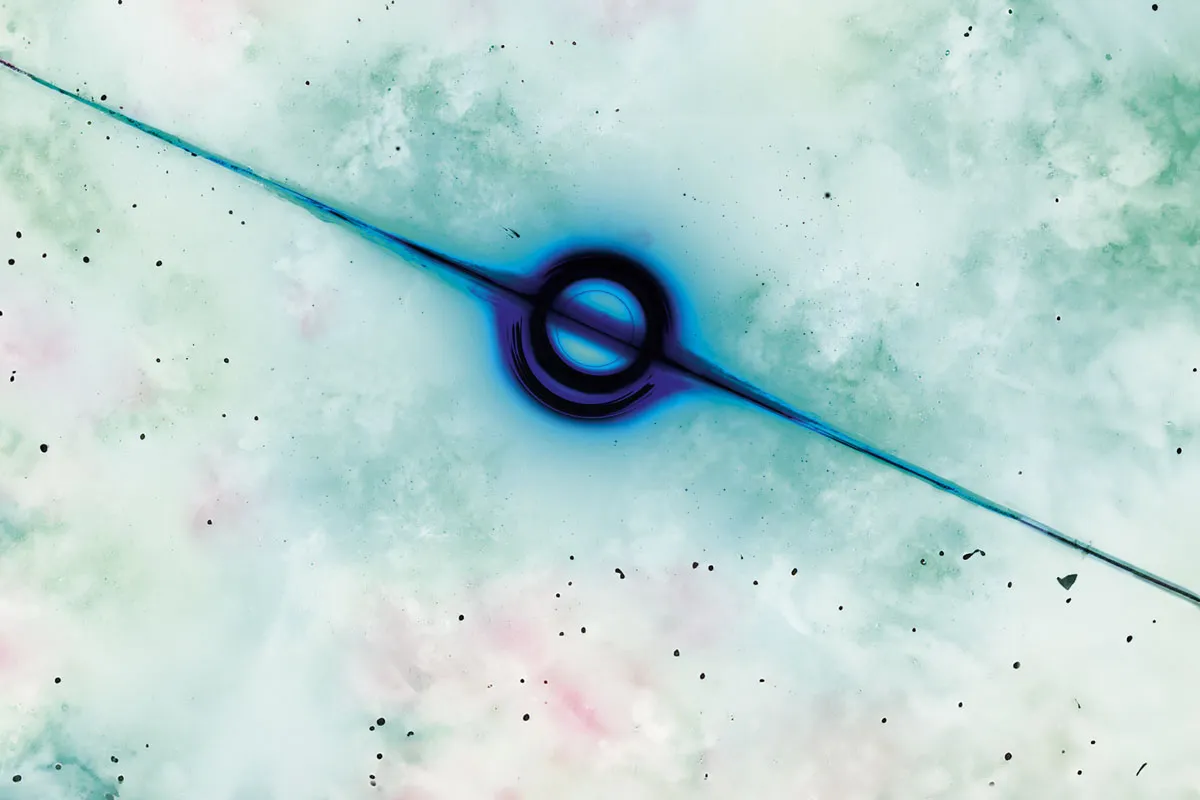
Black Hole other side: One of the most astonishing scientific realizations of recent decades is that the universe is teeming with black holes. They come in a wide range of sizes: some only slightly more massive than the Sun, while others are billions of times heavier.
They are detected in multiple ways: through radio waves emitted by infalling matter; by observing the motion of stars orbiting them; via gravitational waves produced during mergers; and through extreme distortions of light, such as the famous Einstein ring seen in images of Sagittarius A* at the center of the Milky Way.
Read Also: SpaceX and NASA launch astronauts to relieve bare-bones crew at ISS
The universe is not smooth but riddled with these cosmic “holes,” giving it a sieve-like structure. All known physical properties of black holes were predicted by Einstein’s general theory of relativity, which continues to describe them with remarkable accuracy.Yet two major questions remain unanswered: what happens to matter once it falls into a black hole, and how do black holes ultimately end their existence?
Black Hole other side
Decades ago, Stephen Hawking proposed that black holes slowly shrink by emitting thermal radiation, now known as Hawking radiation. Over immense timescales, they evaporate, becoming smaller and smaller. But what happens after that? Einstein’s theory does not provide an answer, because these questions involve the quantum nature of spacetime, an area governed by quantum gravity, for which no complete theory yet exists.Still, physicists have developed promising ideas. One of the most advanced approaches is loop quantum gravity (LQG), a framework developed since the late 20th century to describe quantum spacetime.
According to LQG, the interior of a black hole eventually reaches a stage where quantum effects dominate. At this point, a powerful repulsive force halts the collapse and reverses it, causing the black hole to “bounce.”After this quantum phase, spacetime once again follows Einstein’s equations, but instead of collapsing, it expands. This leads to a theoretical object known as a white hole.
A white hole is essentially the time-reverse of a black hole: instead of trapping everything inside, it expels matter outward. Nothing can enter a white hole, just as nothing can escape a black hole. From the outside, the final stage of black hole evaporation could result in a tiny white hole. These remnants may be long-lived due to quantum effects and are sometimes referred to as “black hole remnants.”This transformation can be thought of as a quantum leap, similar to how electrons jump between energy levels in atoms, emitting photons.
Black Hole other side: LQG also predicts that spacetime is quantized, meaning areas can only take discrete values. As a result, the smallest possible white hole would have an incredibly tiny mass, comparable to a fraction of a microgram. This scenario offers answers to both key questions: matter that falls into a black hole could eventually re-emerge from a white hole, and black holes may end their lives by transitioning into these stable remnants.Interestingly, this idea may also shed light on dark matter. It is possible that the mysterious unseen mass in the universe is partially or entirely made up of ancient white hole remnants formed from evaporated black holes in the early universe.
Detecting such objects directly would be extremely difficult, as they interact mainly through gravity. However, future advances in quantum detection technology may make it possible. If white hole remnants do make up dark matter, some could be passing through regions of space around us even now, unnoticed.For now, scientists continue to explore whether this scenario aligns with observations. The idea challenges earlier assumptions, such as the notion that black hole horizons are eternal.
Modern understanding suggests otherwise: once quantum effects are considered, even the event horizon may not last forever.Reality, it seems, is subtler than once imagined. Perhaps nothing in the universe is truly eternal, not even the shadowy edge of a black hole.
Source: Science Focus