

 |
| Wikipedia |
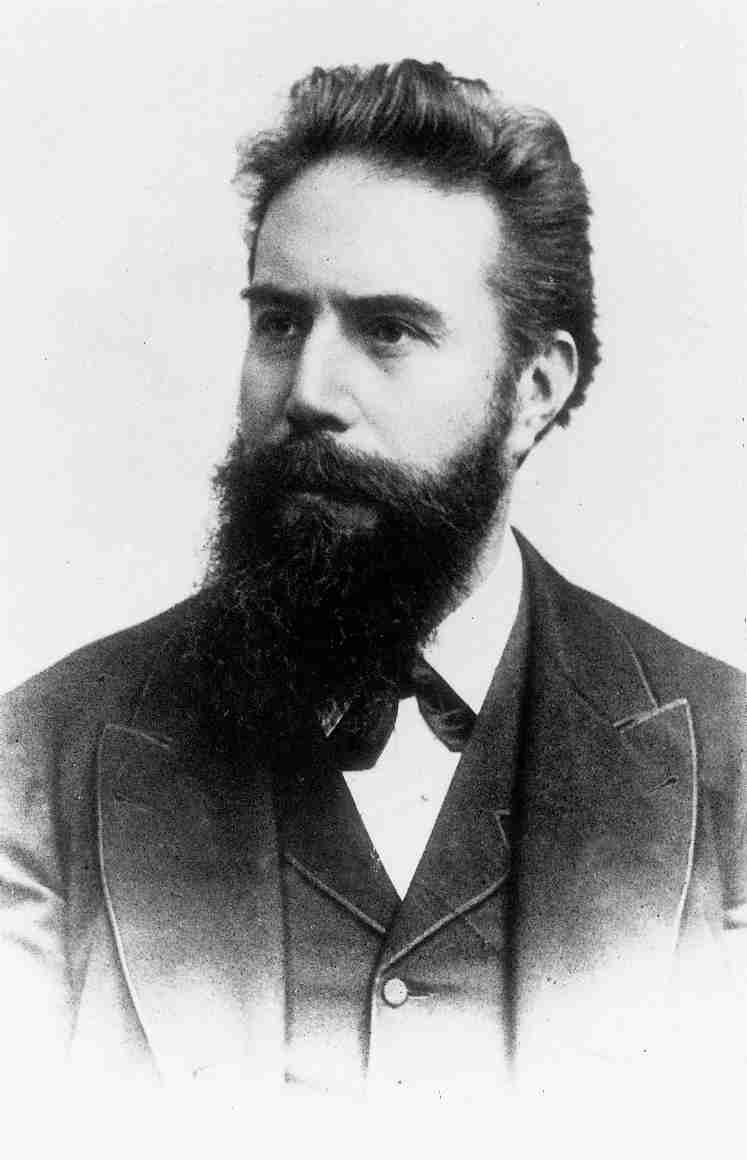
Professor Wilhelm Röntgen said, “I had covered the tube on all sides with black cardboard. A sheet of barium platinocyanide paper was lying on the bench.”
On that day, Professor Röntgen did not know what he had discovered. Because he did not know, he named this unknown radiation “X-ray.” Some people wanted to name it “Röntgen ray” after him, but that did not last. The name X-ray remained. (Although pronounced “Wilhelm Röntgen” in English, in German it is pronounced “Wilhelm Röntgen.” When X-rays were discovered in November 1895, many fundamental aspects of physics were still unknown. Yet, soon after the discovery of X-rays, several major discoveries followed, forming the foundation of twentieth-century physics. In 1896, the French physicist Henri Becquerel discovered radioactivity.
In 1897, Sir J. J. Thomson discovered the electron, a fundamental particle of matter. Interestingly, the technique for producing X-rays in the laboratory was known even before the discovery of the electron. However, it was understood much later that X-rays are produced due to the interaction of electrons within atoms, after the development of quantum mechanics and atomic theory. Sixteen years after the discovery of X-rays, in 1911, Ernest Rutherford discovered the proton. Two years later, Niels Bohr presented an acceptable quantum model of the atom. From the structure of atoms and the quantum behavior of electrons, we can now explain how X-rays are produced.
Although the nature of X-rays was unknown at the time of discovery, today we know much about them. X-rays are extremely high-frequency electromagnetic waves. Their wavelength is extremely short, and their energy is very high. The frequency of X-rays ranges from 3×10¹⁶ hertz to 3×10¹⁹ hertz. That means these rays can produce up to 3×10¹⁹ waves per second. Their wavelength is less than 10 nanometers (one nanometer is one billionth of a meter).
Naturally, waves this small cannot be seen with the human eye. X-rays can easily pass through the human body. They can enter from one side of an object and exit from the other. X-rays carry no electric charge, so they are not affected by electric or magnetic fields. Although visible light and X-rays belong to the same electromagnetic family, X-rays do not reflect or refract like visible light. X-rays have no mass, so they are not matter. They cannot be seen, touched, or felt. X-rays cannot be stored; they must be used immediately after being produced.
With technological advancement, the use of X-rays has increased greatly. From airport security checks to space-based X-ray observatories, their applications are widespread. Their use in medical science is especially essential. The radiographs produced using X-rays are commonly referred to simply as X-rays. Each year, about 4 billion medical X-rays are performed worldwide for diagnosis. This means, on average, one out of every two people undergoes at least one medical X-ray each year. Unlike the inventors of computers and smartphones, who are among the wealthiest people today, Röntgen gave the intellectual property of X-rays freely to humanity. He spent his final years in poverty and died of cancer. Great contributions often come with great sacrifice.
X-rays are produced in different ways depending on their application, but the fundamental principle remains the same. In medical diagnosis, X-rays are produced inside a vacuum tube, just as Röntgen first unknowingly produced them in a Crookes tube in 1895. Even after more than 125 years, the basic production method remains unchanged, although imaging techniques have improved with computer technology.
Inside the X-ray tube, one side contains the cathode or filament, and about two centimeters away is the anode or target. A very high voltage, ranging from 30,000 to 140,000 volts, is applied between them using a high-voltage generator. This process takes only a few seconds. Due to the strong attraction between the cathode and anode, millions of electrons are released from the filament and accelerate toward the anode. The higher the voltage, the greater the speed and energy of the electrons. When these electrons collide with electrons in the atoms of the anode, interactions occur.
If an incoming electron knocks out an electron from the innermost energy level (the K-shell), a vacancy is created. Electrons from higher energy levels (L, M, or N shells) quickly move down to fill the vacancy. Since higher-level electrons have more energy, they release excess energy when moving to a lower level. This released energy is emitted as X-rays, carried by quantum particles called photons. These are known as characteristic X-rays.
Another type of X-ray is also produced, called bremsstrahlung (German for “braking radiation”). When fast-moving electrons pass close to the nucleus without direct collision, their speed decreases due to the nucleus’s positive charge. This loss of energy is emitted as X-rays. This type forms the majority of X-rays produced. Tungsten is used for both the filament and the anode target. Tungsten can withstand extremely high temperatures and contains many electrons, increasing the chances of interaction. The anode is a strong rotating metal disc that helps distribute heat produced during electron collisions.
Since X-rays are ionizing radiation, safety precautions must be followed. When X-rays pass through the human body, some are absorbed by bones and tissues, while others pass through. The transmitted rays are captured by detectors, and the differences in absorption create an image of the internal structure. Today, this entire process takes only seconds with modern computer technology.
X-rays, once an accidental discovery glowing faintly on a sheet of paper, have become one of humanity’s most powerful invisible tools, revealing the hidden architecture of both bone and cosmos.