

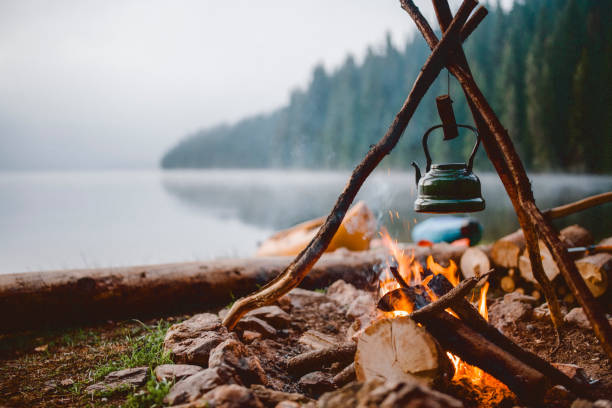
On a cold night, imagine sitting beside a blazing campfire. The wood crackles and slowly turns into ash, while just above it, an iron or aluminum pot sits calmly, heating soup without burning away. This curious contrast raises a simple but fascinating question: Why Wood Burns but Metal Does not?
To understand this, we first need to know what fire really is. Fire is a chemical reaction that requires three essential elements: heat, oxygen, and fuel. Oxygen comes from the air around us, heat can come from a spark or friction, and fuel is the material that actually burns.Wood burns easily because it is made mostly of cellulose, a substance composed of carbon, hydrogen, and oxygen. The chemical bonds in cellulose are relatively weak. When wood is heated, these bonds break apart and react with oxygen, forming more stable molecules like carbon dioxide and water vapor. During this transformation, energy is released in the form of heat and light, which we see as flames.
Why Wood Burns but Metal Does not?
In contrast, metals like iron or aluminum behave very differently. Their atomic structure is held together by strong metallic bonds, which do not break easily under normal fire conditions. Instead of burning, metals absorb heat and spread it quickly across their entire surface. This high thermal conductivity prevents any one part of the metal from reaching the temperature needed to ignite or break apart. As a result, the pot becomes very hot but does not burn.
Suggested Read: What changes occur inside the body when exposed to chemical weapons?
Interestingly, some metals can burn, but only under special conditions. Metals like potassium or titanium can catch fire, especially when they are in powdered form. When ground into fine particles, their surface area increases, allowing them to react rapidly with oxygen. This is why such metals are often used in fireworks, producing bright and colorful sparks.A similar principle can even prevent other materials from burning. For example, if you fill a paper cup with water and place it over a flame, the paper may not burn. This happens because the water absorbs the heat, keeping the paper’s temperature below its ignition point.
In the end, the difference comes down to how materials handle heat and how strong their chemical bonds are. Wood releases energy and burns because its bonds break easily, while metals resist burning by absorbing and distributing heat efficiently.
Source: livescience.com