

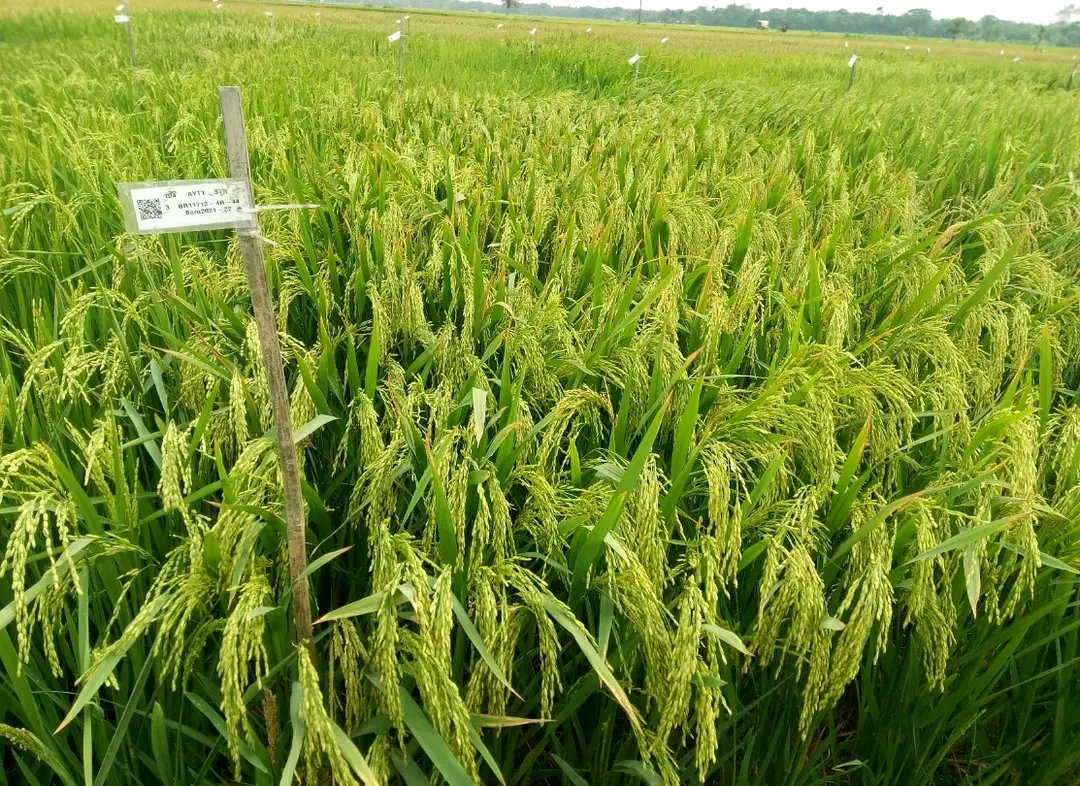
Six new rice varieties, including two hybrids, have been added to the country’s grain bank. The six new high-yielding rice varieties developed by the Bangladesh Rice Research Institute (BRRI) were released for cultivation across the country at the 115th meeting of the National Seed Board held at the Ministry of Agriculture on February 5.
 |
| Bri rice 117 | File photo |
Since its establishment, BRRI has been making outstanding contributions to ensuring food security for the growing population of this country in the last five and a half decades. In the last 55 years, BRRI has developed a total of 127 rice varieties, including 117 inbreeds and 10 hybrids. To cope with the country’s geographical diversity—such as drought in the north, salinity in the south, floods in the central region, coastal submergence and cold-tolerant varieties—BRRI has developed 41 varieties including salinity-tolerant, drought-tolerant, submergence-tolerant, cold-tolerant, and tidal-ebb-tolerant varieties. Not only has it been developed for adverse environmental conditions, BRRI has also developed 27 nutrient-rich rice varieties and 14 slender and fragrant rice varieties. They are exportable to the international market. The company has brought Bangladesh to a glorious position in the world by developing 7 zinc-rich varieties, including the world’s first zinc-rich rice, BRRI Dhan 62.
The average height of a mature plant is 100 centimeters. The rice is long and slender. The rice is dark brown in color and the color of the rice grains is black. The weight of 1000 matured rice is about 17.8 grams.
Among the newly developed varieties, Bri Dhan 115 is a variety rich in vitamin-E and antioxidants. It is the first high-yielding black rice variety in Bangladesh, which was developed by scientists of the Biotechnology Department of Bri using the anther culture method. The average yield of this variety is 7.4 tons per hectare and the life span is 137-142 days. The average height of a mature plant is 100 centimeters. The rice is long and slender. The rice is dark brown in color and the color of the rice grains is black. The weight of 1000 matured rice is about 17.8 grams. The amylose of this rice is 23 percent. The amount of vitamin-E and cyanidin-3-glucoside in the rice grains is 14.98 mg/kg and 29.12 mg/kg, respectively. In addition, the rice grain contains 536.61 μM AAE antioxidants per 100 grams.
The newly developed Bri Dhan 116 is a high-yielding Nabi variety of the Boro season. The variety is a long-lived variety contemporary to Bri Dhan 92. Its average lifespan is 154 days. The shape and size of the rice of this variety is medium-thin and narrower than that of Bri Dhan 92. Since the plant is strong and sturdy, this variety does not easily fall. Since the dig leaves of this variety are erect and long, the rice ears are not visible from above. Its leaves remain green even when the rice is ripe. In the yield test of the proposed variety, it gave about 13.75 percent more yield than Bri Dhan 92 in ten regions. The average yield per hectare of this variety is 8.59 tons. However, if properly managed in a suitable environment, the variety is capable of yielding up to 10.36 tons per hectare. Since its cultivation method is similar to Bri Dhan 29 and 92, it can be cultivated as an alternative to Bri Dhan 29 and 92.
The newly developed Bri Dhan 117 is a short-lived salinity-tolerant and blast-resistant variety for the Boro season. Earlier, Bri had developed another blast-resistant variety called Bri Dhan 114. The average yield of Bri Dhan 117 is 8.6 tons per hectare, which is 1.5 tons more than Bri Dhan 114. However, with proper care, the yield of Bri Dhan 117 can be obtained up to 9.90 tons per hectare. The grains of this variety are medium-sized and golden in color. The life span of this variety is 129-135 days, which is the same as the popular Boro season variety Bri Dhan 28. The amylose content of the rice grain is 24.2 percent and the protein content is 9.3 percent. The rice is smooth. The special feature of the variety is that in addition to its salt tolerance, it is resistant to blast disease and has shown high blast disease resistance in artificial inoculation.
The newly developed Bri rice is a cold-tolerant rice variety suitable for 118 haor areas. Since this variety is cold-tolerant at the breeding stage, it was developed to avoid the risk of paddy being submerged in the semi-ripe to ripe stage due to sudden floods in the haor. 17 percent of the country’s total boro production comes from the haor area. Paddy being submerged due to cold weather during the seedling stage and upstream flooding during the semi-ripe to ripe stage has been a long-standing problem in the haor area. This short-lived variety will be able to solve that problem. It will not be shriveled even if sown early (October 25-November 1) and is capable of yielding at least 6.0 tons/hectare. However, it is capable of yielding up to 6.9-8.5 tons/hectare in 145 days when sown during normal times (November 15-20). The size and shape of the rice of this rice is medium thick. The rice is neat and white. The amylose content of this rice is 28.3 percent. In addition, the protein content is 9.1 percent. In the yield test of the proposed variety, it gave about 22.83 percent more yield than Bri Dhan 28 in ten regions.
Two newly developed salinity-tolerant and lodging-tolerant hybrid rice varieties are Bri Hybrid Dhan 9 and Bri Hybrid Dhan 10. Among them, Bri Hybrid Dhan 9 is resistant to lodging and is moderately tolerant to salinity. It can tolerate salinity levels of 4-8 ds/m from seedling to maturity. Its grain size is medium and the amylose content in the grain is 23.6 percent.
Author: Bangladesh Rice Research Institute (BRI), Gazipur