

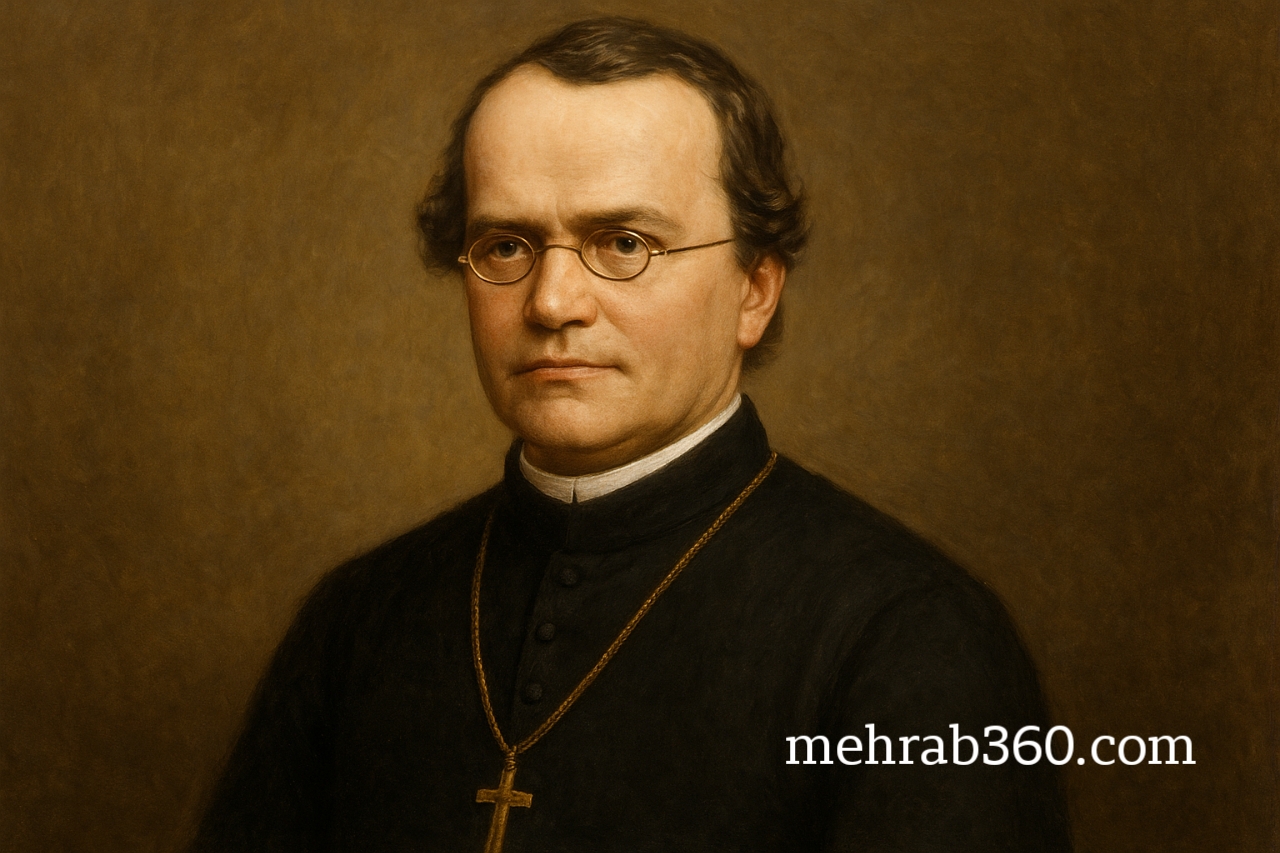
Who was Mendel? Gregor Johann Mendel (1822-1884), known as the father of modern genetics, was an Austrian priest. After conducting various experiments on various pea plants for seven years, he introduced two “laws” of heredity. His laws are called Mendel’s laws or Mendelism. The theory given by Mendel is considered the basis of current genetics.
Brief biography of Mendel:
The son of a farmer, Johann Mendel was born in Austria in 1822. His dream was to become a teacher and scientist. But all his hopes and aspirations were dashed by poverty. After abandoning his studies at the university, he joined the church in the city of Brunn, Austria, as an apprentice.
In 1857, Mendel collected 34 varieties of peas (Pisum sativum) and began experiments to unravel the mystery of plant heredity in the garden adjacent to the church. After seven long years of difficult and laborious experiments, he discovered two laws of heredity. He submitted all the papers of his experiments to the Natural History Society of Brunn in 1866. No one in the 19th century could realize the importance of this seemingly simple experiment. On January 6, 1884, long before his laws were established, Mendel died. Sixteen years after his death, in 1900, three scientists from three different countries independently but simultaneously rediscovered the results of Mendel’s research.
The scientists are:
1. Dutch botanist Hugo de Vries (1848-1935),
2. German botany professor Carl Correns (Car) Correns, 1864-1933) and
3. Austrian agronomist Erich Tschermak (Erich Tschermak, 1871-1962)
Surprisingly, these scientists became aware of Mendel’s research after completing all their experiments. Thus, the foundation laid by Mendel’s research through the discovery and publication of the basic principles of heredity led to the development of an important branch of biology called genetics. For this reason, Mendel is called the Father of Genetics.
Reason for choosing Mendel’s pea plant for his experiment
Mendel selected pea plants as a sample for his experiment because certain characteristics were observed in the garden pea plant (Pisum sativum).
1. Since the pea plant is an annual, it can be easily grown in the garden and in pots.
2. Since the lifespan of each species of the pea plant is short, the results of the hybridization experiment can be obtained in a very short time.
3. Since the pea flower is bisexual, self-pollination occurs easily.
4. Since the pea flower is self-pollinating, no other characteristics from outside can easily mix, as a result, it is possible to produce pure offspring with specific characteristics in the offspring.
5. Since the flowers are large in size, it is also possible to cross-pollinate the pea plant very easily.
6. There are clear comparative hereditary characteristics in the pea plant – for this reason, many varieties of pea plants are present.
7. The offspring created as a result of hybridization are fertile;
Reasons for Mendel’s success or success
Many scientists had conducted hybridization experiments before Mendel. But Mendel was the first to arrive at some accurate conclusions based on such experiments. The main reasons for his success are-
1. He experimented with pea plants, which are self-pollinating. Since the possibility of cross-pollination is low due to the special structure of the flower, the possibility of error in the experiment was very small.
2. The plants he used in various experiments were pure, i.e. homozygous.
3. In his various experiments, one gene of each pair of genes was completely dominant over the other gene.
4. There are seven pairs of chromosomes in the diploid cell of pea.
5. The seven pairs of characters that Mendel worked with were located on different chromosomes, so there was no linkage problem.
6. If he encountered any linked character, Mendel might have failed to explain the second law. But fortunately, none of the seven pairs of characters determined by Mendel were linked characters.
7. He repeatedly tested the purity of the plants before hybridizing.
8. He bred the plants for several generations to reach a definite conclusion.
9. Mendel recorded the results of his research with great care and diligence.
10. Mendel interpreted his results meaningfully using mathematical methods.