
Everyone knows that a galaxy is a vast cosmic structure made up of stars. But this simple definition does not capture the full reality of a galaxy. A galaxy also contains gas, dust, planets, moons, comets, asteroids, and of course the mysterious dark matter. However, there exists a special type of galaxy composed almost entirely of dark matter, making it extremely difficult to detect. These are known as dark galaxies, and they contain either no stars or only a very small number of them. Scientists have theorized the existence of such galaxies for decades, though until recently they remained largely hypothetical. Researchers had previously identified low-brightness galaxies and possible dark galaxy candidates, but now a new study has revealed the strongest candidate yet.
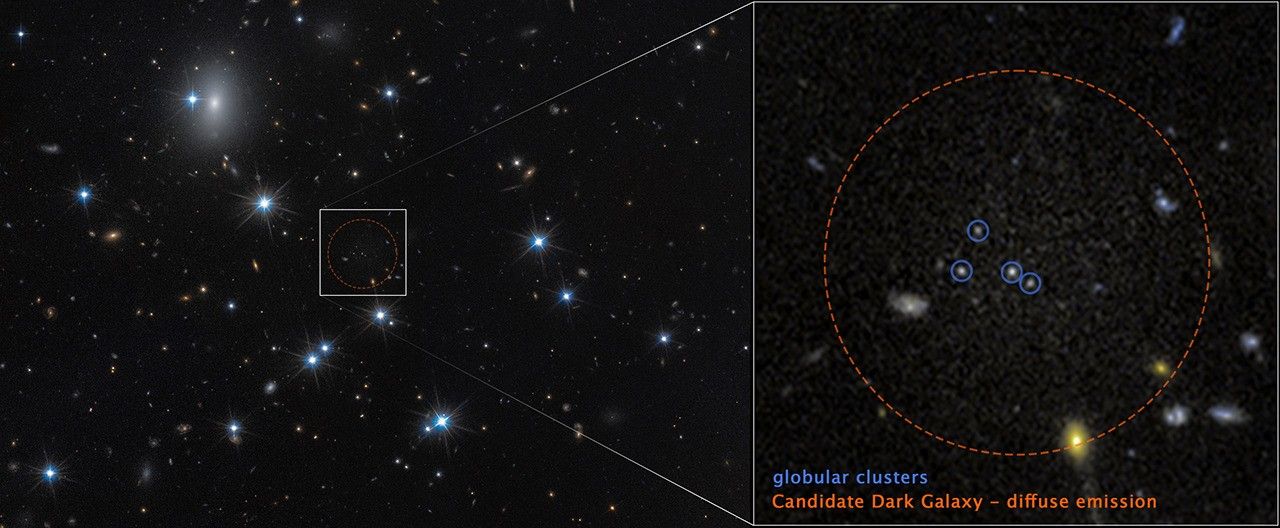
The lead author of the study, a professor at the University of Toronto, and the research team have named this potential galaxy CDG-2, which stands for Candidate Dark Galaxy 2. It is located in the Perseus Cluster, about 300 million light-years from Earth. Naturally, this raises an intriguing question: if it is so dark, how was it detected at all? The answer lies in globular clusters. Most galaxies contain globular clusters, which are tightly bound spherical groups of stars that can contain hundreds of thousands to millions of stars.
In spiral galaxies such as our own Milky Way Galaxy, these clusters are usually found in the outer halo region. However, their origin and role in galaxy evolution remain only partially understood. In this study, scientists used three powerful astronomical observatories, including the Hubble Space Telescope, the Euclid space telescope, and the Subaru Telescope. They searched for dense groupings of globular clusters that could signal the presence of an otherwise invisible galaxy.
Hubble first identified four closely grouped globular clusters within the Perseus Cluster. The researchers then applied advanced statistical methods to analyze combined data from all three telescopes. Their analysis revealed an extremely faint glow surrounding the clusters. This faint light strongly indicates the presence of a galaxy whose individual stars are too dim to be directly observed.
According to the lead author, this is the first galaxy ever identified solely through its globular cluster population. Their calculations suggest that these four clusters likely represent the entire globular cluster system of CDG-2. If this is correct, these clusters account for about 16 percent of the galaxy’s visible light. The total brightness of CDG-2 is estimated to be equivalent to about 6 million Suns. The study further notes that CDG-2 is one of the faintest known galaxies associated with globular clusters, with a significant portion of its total light confined within those clusters.
When researchers combined images from Hubble and Euclid, the diffuse and extremely faint glow around the four clusters became clearly visible. This glow is not an observational error but strong evidence of a real galaxy. The discovery of CDG-2 has also renewed interest in another candidate dark galaxy called CDG-1. Scientists believe CDG-1 may be even darker and contain fewer stars than CDG-2.
It is even possible that such galaxies are composed almost entirely of dark matter, with only globular clusters remaining visible. One possible explanation for CDG-2’s origin is that interactions with other galaxies in the Perseus Cluster stripped away its star-forming gas, leaving behind only dark matter and tightly bound globular clusters. Because globular clusters are held together by strong gravitational forces, they are more resistant to cosmic tidal effects. This study demonstrates that globular clusters may serve as reliable signposts for detecting dark galaxies and offers a powerful new window into the invisible structure of the universe.
Source: www.sciencealert.com