

Climate scientists prefer their planetary ledger tidy and balanced, tracking how shifting energy flows drive sea level rise, ice melt, and other consequences of climate change, because precise accounting is essential for understanding both current changes and future outcomes.
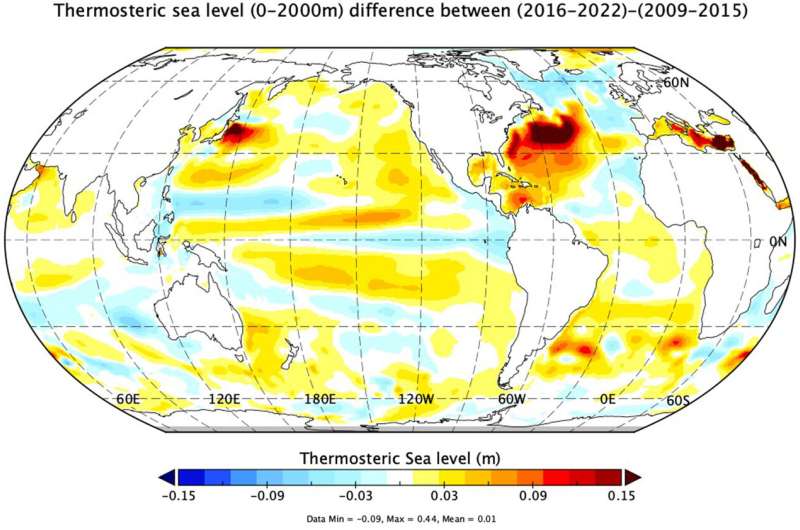
Until 2016, the global mean sea level (GMSL) budget, which sums all contributors to sea level rise, was considered “closed,” meaning observed changes matched calculated causes, but after 2016 a gap appeared, particularly when relying on ocean heat data down to 2,000 meters, leaving part of the recent rise unexplained. New research published in Earth’s Future has now effectively closed that gap by showing that warming in the deep ocean, below 2,000 meters, plays a crucial and previously underestimated role, restoring balance to the sea level budget.
Led by Anny Cazenave of the Laboratory of Space Geophysical and Oceanographic Studies in Toulouse, the study found that including thermal expansion from deep ocean heating allows the GMSL budget to be almost fully reconciled since 2016, with deep waters contributing about 0.4 millimeters per year, roughly 10 percent of observed sea level rise between 2005 and 2022, though with about 40 percent uncertainty. While the global ocean averages a depth of 3,682 meters, much deeper regions remain poorly observed because the global network of over 4,000 Argo buoys, deployed since the mid-2000s, measures temperature, salinity, and pressure only within the upper 2,000 meters, cycling up and down and transmitting data via satellite, which has enabled scientists to calculate that the upper ocean has absorbed about 220 zettajoules of heat since 2005, equivalent to 0.67 watts per square meter of Earth’s surface and an average temperature increase of 0.077°C.
However, these instruments do not reach deeper layers, and although Deep Argo buoys capable of descending to 4,000 to 6,000 meters are planned, only a limited number had been deployed by March 2026, insufficient for robust global estimates. To bridge this observational gap, researchers turned to climate reanalysis, a method that blends historical measurements with numerical models to reconstruct missing data, similar to how the 20th Century Reanalysis estimated past climate conditions using surface pressure and marine observations before widespread thermometer coverage.
By combining satellite altimetry from Copernicus, in situ temperature data from multiple Argo datasets, ocean mass estimates derived from GRACE satellite measurements, glacier mass balance records, ice sheet data from Greenland and Antarctica, and land water storage changes such as dam filling and overflow, along with the 2024 CIGAR ocean reanalysis, the team created a comprehensive picture of sea level drivers. Their results showed that without accounting for deep ocean warming, the post-2016 rise could not be fully explained, but once included, the missing piece fell into place, confirming that deep ocean heat uptake is now a significant contributor.
The next challenge, the researchers note, is to determine whether this deep ocean change arises from natural climate variability, human-driven forcing, or a blend of both, a question that may be answered using advanced coupled climate models that simulate interactions between the atmosphere, ocean, land surface, and sea ice.