

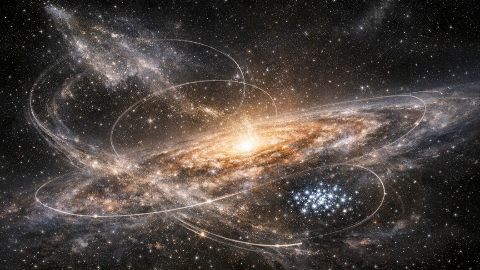
The Milky Way galaxy grew into its present form by gradually merging with and consuming smaller galaxies, leaving behind stellar fingerprints that astronomers can trace through orbital eccentricities and chemical compositions. By examining these traits, researchers can identify groups of stars that originated outside the Milky Way and reconstruct the properties of their parent systems.
A recent study published in Monthly Notices of the Royal Astronomical Society analyzed 20 stars believed to have formed together in a dwarf galaxy named “Loki,” which merged with the Milky Way early in its evolution. These stars are metal poor, meaning they contain very small amounts of heavy elements, yet they show distinct chemical patterns compared to other metal poor stars in the Milky Way’s halo.
The earliest stars in the universe consisted mainly of hydrogen and helium, gradually forging heavier elements through nuclear fusion, and passing these materials on to later generations of stars. Astronomers classify stars with low levels of heavy elements such as iron as metal poor, and early dwarf galaxies composed of such stars acted as the building blocks of larger galaxies.
According to the study, these primitive building blocks merged during early cosmic epochs, dispersing their stars, gas, and dark matter into a growing proto galaxy. As a result, the oldest and most metal poor stars are expected to reside in the inner regions of the Milky Way, while stars from later mergers are more commonly found in the outer halo. Observations support this pattern, showing that many extremely metal poor stars exist in the halo, with fewer located in the galactic plane.
The research focused on 20 metal poor stars within the galactic plane, including both prograde and retrograde orbiting stars, all with relatively high orbital eccentricities. Their chemical abundances were compared with those of halo stars, dwarf galaxies, and simulated stellar populations. The analysis revealed signatures of enrichment from energetic cosmic events such as supernovae, hypernovae, fast rotating massive stars, and neutron star mergers, but notably lacked evidence of white dwarf explosions.
These chemical patterns suggest that the stars originated from a short lived but highly energetic dwarf galaxy, rather than from multiple separate systems. The similarity in chemical signatures between prograde and retrograde stars further supports the idea that they share a common origin.
Although the possibility of two separate systems was considered, the researchers concluded that a single dwarf galaxy scenario is more consistent with the data, as it better matches the observed mass and chemical evolution patterns. The study emphasizes that the small sample size limits definitive conclusions, but future large scale spectroscopic surveys such as WEAVE survey and 4MOST survey are expected to provide clearer insights into the origins of metal poor stars in the Milky Way’s galactic plane.
Source: phys.org