

At the center of the Milky Way lies a massive elongated bar-like structure that influences stellar motion, and while earlier theories suggested that its gravitational pull would prevent stars from moving outward, the new findings indicate that during its formation billions of years ago this structure was unstable, creating a window of opportunity for stars like the Sun to be pushed away from the dense and chaotic inner regions into calmer outer zones of the galaxy.
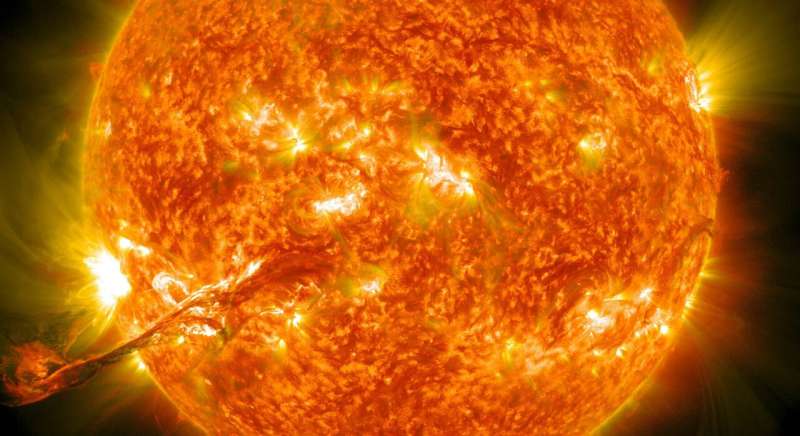
This outward journey may have been crucial for life on Earth because regions closer to the galactic center are crowded with stars and prone to intense radiation and explosive cosmic events, whereas the Sun’s current position offers a quieter and more stable environment, making it far more suitable for the development and long-term survival of life on planets like Earth.
Published in the journal Astronomy & Astrophysics and reported by Earth.com
What is Sun Birthplace Discovery
Sun Birthplace Discovery is transforming how we understand the origin of our Sun, revealing that it was not born in its current location but instead migrated across the Milky Way billions of years ago
This discovery suggests that the Sun is more like a cosmic traveler than a stationary object, drifting through the galaxy over time along with thousands of sibling stars.
Suggested Read: How long does a planet live?
How Scientists Tracked the Sun’s Origin
The journey behind Sun Birthplace Discovery began when scientists analyzed thousands of stars similar to the Sun, known as solar twins, using data from the Gaia Mission.
Researchers led by Daisuke Taniguchi at Tokyo Metropolitan University created advanced models to trace star movements and ages.
They discovered that many stars near the Sun share a similar age of about 4.6 billion years, suggesting they formed together and later migrated outward.
Role of the Milky Way in Sun Birthplace Discovery
Sun Birthplace Discovery highlights how dynamic the Milky Way galaxy really is, with its central bar-shaped structure acting like a gravitational engine that can push stars outward.
Earlier theories suggested stars could not escape the galaxy’s inner region, but new findings show that during its early formation phase, gravitational instability allowed stars like the Sun to move outward.
Future Research on Sun Birthplace Discovery
Scientists are continuing Sun Birthplace Discovery research by searching for stars with identical chemical compositions to the Sun. Finding such stars would act like a galactic fingerprint, helping pinpoint the exact birthplace of our Sun. The research has been published in Astronomy & Astrophysics, opening new doors in space science.
Why Sun Birthplace Discovery Matters for Life
Sun Birthplace Discovery is not just about astronomy, it also explains why life exists on Earth. The inner regions of the galaxy are crowded and dangerous, filled with radiation and stellar explosions, while the Sun’s current position is calmer and safer. This peaceful galactic neighborhood allowed Earth to develop and sustain life over billions of years
Solar Twin Stars and Their Importance
Solar twins are crucial to Sun Birthplace Discovery because they act like cosmic mirrors reflecting the Sun’s past. Scientists use spectroscopy and chemical analysis to compare these stars, helping them reconstruct where the Sun originally formed. This work falls under the field of Astronomy, where determining stellar age is one of the toughest challenges
Determining the age of stars remains one of the most challenging puzzles in Astronomy. but researchers analyzed starlight and chemical signatures through advanced computer simulations and found that many nearby stars share a similar age to the Sun, around 4.6 billion years, reinforcing the idea that they were born together and later migrated outward from the galactic center as a group during a turbulent phase of galactic evolution.