
 |
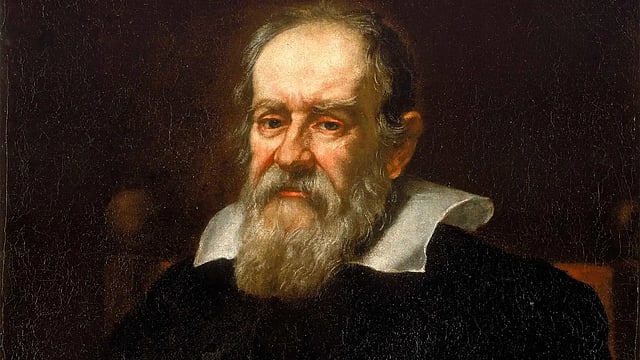
| Justus Sustermans |
From textbook pages to pop songs, and even in tales of space exploration, the name Galileo Galilei shines like an immortal star. But how many of us truly know the man behind the name? Sitting in a modest laboratory in Pisa, he transformed the very way humanity sees the universe.
We often memorize scientists’ discoveries, yet forget the labor, uncertainty, and struggle behind them. The Galileo Museum in the Italian city of Florence is dedicated to telling exactly that story. Here, Galileo is not portrayed as a superhuman figure, but as a tireless and determined scientist. Let us take a walk through the museum with guide Ilenia Ulivi and learn more about him.
In the museum’s early rooms, visitors encounter astrolabes. These were essentially the computers of their time. They were used to determine the positions of stars, tell time, and even find one’s location by observing the North Star. Galileo himself used such instruments to create horoscopes for the powerful Medici royal family. Surprising, perhaps, but in that era astronomy and astrology were closely intertwined, much like alchemy and chemistry.
In the next room stands a magnificent armillary sphere built for Grand Duchess Christina of Lorraine. This golden globe represents the Earth-centered model proposed by Claudius Ptolemy, with Earth at the center and the Moon, Sun, and planets revolving around it.
Galileo was born in Pisa but taught at the University of Padua, near the Republic of Venice. The famous Venetian glassmakers gave him a major advantage. At the time, Europe had a primitive device known as the “Dutch toy.” In 1608, Hans Lippershey applied for a patent for it. Galileo transformed this toy into a powerful scientific instrument. His surviving shopping lists are astonishing. Alongside chickpeas and peas appear flat glass, lens-grinding powder, and cannonballs. Cannonballs were used to polish lenses. By 1609, he had created lenses capable of magnifying objects 30 times.
Interestingly, Galileo first introduced the telescope not as a scientific tool, but as a weapon of war. He demonstrated it to Venice’s ruler, showing that enemy ships could be spotted long before they were visible to the naked eye. One section of the museum is devoted to the science of warfare. Galileo discovered that projectiles follow curved paths and invented a geometric compass to help artillery measure firing range. His obsession with precise measurement led him to discover the laws of motion. Using inclined planes, he showed that falling objects accelerate at the same rate regardless of their weight.
At the heart of the museum stand two telescopes built by Galileo himself. Nearby is a cracked lens through which he first observed Jupiter’s moons: Io, Europa, Ganymede, and Callisto. These are not replicas, but original instruments. These fragile pieces of glass proved that not everything revolves around Earth. His discoveries earned him a prestigious position in Florence but also sparked conflict with the Church. Galileo’s findings challenged the long-held teachings rooted in the ideas of Aristotle. The Church believed Earth was the center of the universe. But Galileo’s telescope revealed otherwise. By observing the phases of Venus, he confirmed that Venus orbits the Sun, not Earth.
When he published his famous book, Dialogue Concerning the Two Chief World Systems, the Roman Inquisition summoned him. According to legend, after being forced to recant his views, he whispered, “And yet it moves.” He spent the last eight years of his life under house arrest at his villa in Arcetri.
Even in confinement, he continued his work. He studied pendulums, temperature, and motion. His thermoscope became the precursor to the thermometer. His improvements in lens-making helped pave the way for the microscope. His student, Evangelista Torricelli, later invented the barometer.
Galileo died in 1642. Nearly a century later, when his remains were moved to a grand tomb in the Church of Santa Croce, devoted admirers removed some of his bones. Today, one of his fingers is displayed in the Galileo Museum, preserved in a glass jar and pointing eternally toward the sky, as if still guiding humanity toward the stars.
Source: The Florentine