

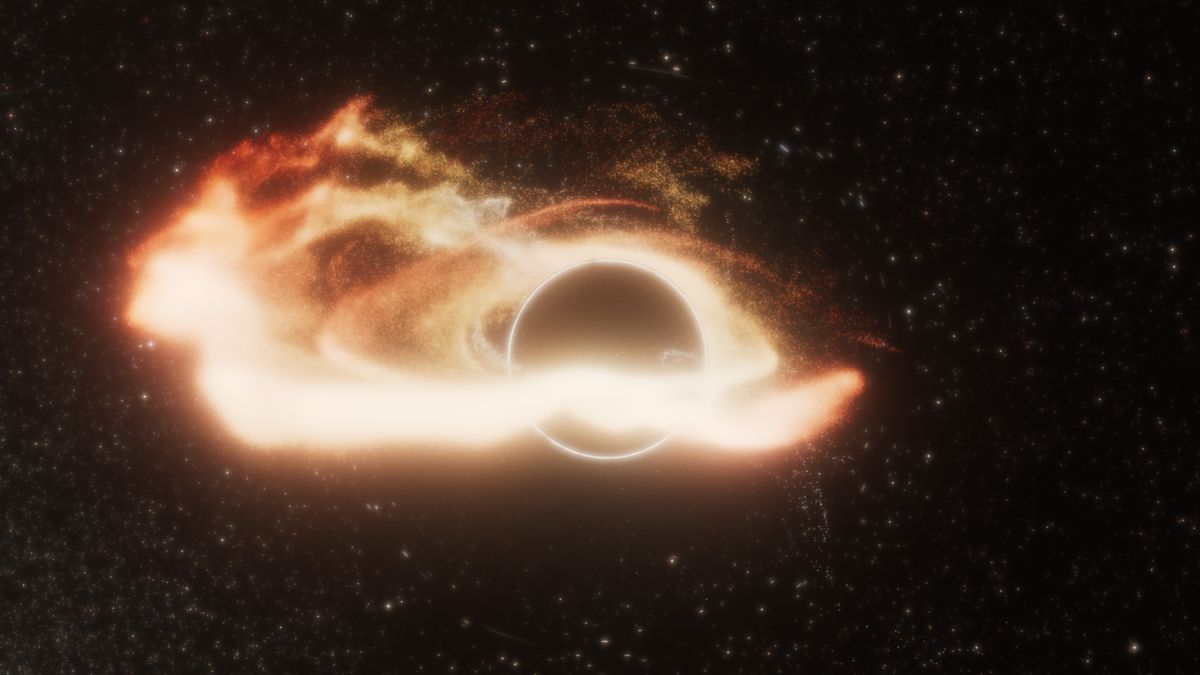
A powerful burst of X-rays that began its journey 8 billion years ago has reached Earth, carrying with it what may be the first clear evidence of a white dwarf star being violently torn apart by an intermediate-mass black hole, a cosmic predator long suspected but rarely seen in action.
 |
| NASA Image |
The extraordinary event, designated EP250702a, was first detected in July 2025 by the Einstein Probe, which recorded one of the brightest and most unusual X-ray flares ever observed. The study, coordinated by astrophysicists Dongyue Li and Wenda Zhang of the Chinese Academy of Sciences, revealed that the flare’s intensity, duration, and evolution match theoretical predictions for a tidal disruption event involving a white dwarf and a mid-sized black hole.
White dwarfs themselves are incredibly dense stellar corpses formed when stars like our Sun exhaust their fuel and shed their outer layers, leaving behind a core roughly the size of Earth yet containing up to 1.4 times the Sun’s mass, making them second only to neutron stars and black holes in density. According to co-first author Jinhong Chen of the University of Hong Kong, advanced simulations showed that the intense tidal forces of an intermediate-mass black hole interacting with such a dense object can produce energy jets and brightness patterns that align remarkably well with the observations.
About one day after the initial X-ray flash, the Fermi Gamma-ray Space Telescope, operated by NASA, detected a gamma-ray burst from the same location, confirming that this was not a typical stellar explosion but something far more exotic. Over the following 20 days, the signal faded dramatically, dropping by more than 100,000 times in brightness and shifting from high-energy to lower-energy X-rays, a transformation consistent with stellar material being shredded, heated, and consumed by a black hole’s immense gravity. Astronomer Lixin Dai explained that this model best accounts for both the rapid evolution and the extreme energy output of the event, especially since it occurred in the outskirts of its host galaxy, where older stars like white dwarfs are more common.
This discovery may finally provide direct evidence of intermediate-mass black holes, which occupy the mysterious middle ground between stellar-mass and supermassive black holes and have remained largely invisible until now, and it opens a new window into understanding how black holes grow, evolve, and interact with the stars around them, turning distant galaxies into silent theaters of cosmic destruction and transformation.
Source: ScienceAlart