

The Earth’s core is not only made of iron (Fe), but is also thought to contain carbon (C) and research suggests that it contains some oxygen (O2) and possibly silicon (Si). The Earth’s core is a very important part of the Earth’s evolution, as it not only plays a role in producing our planet’s magnetic field.
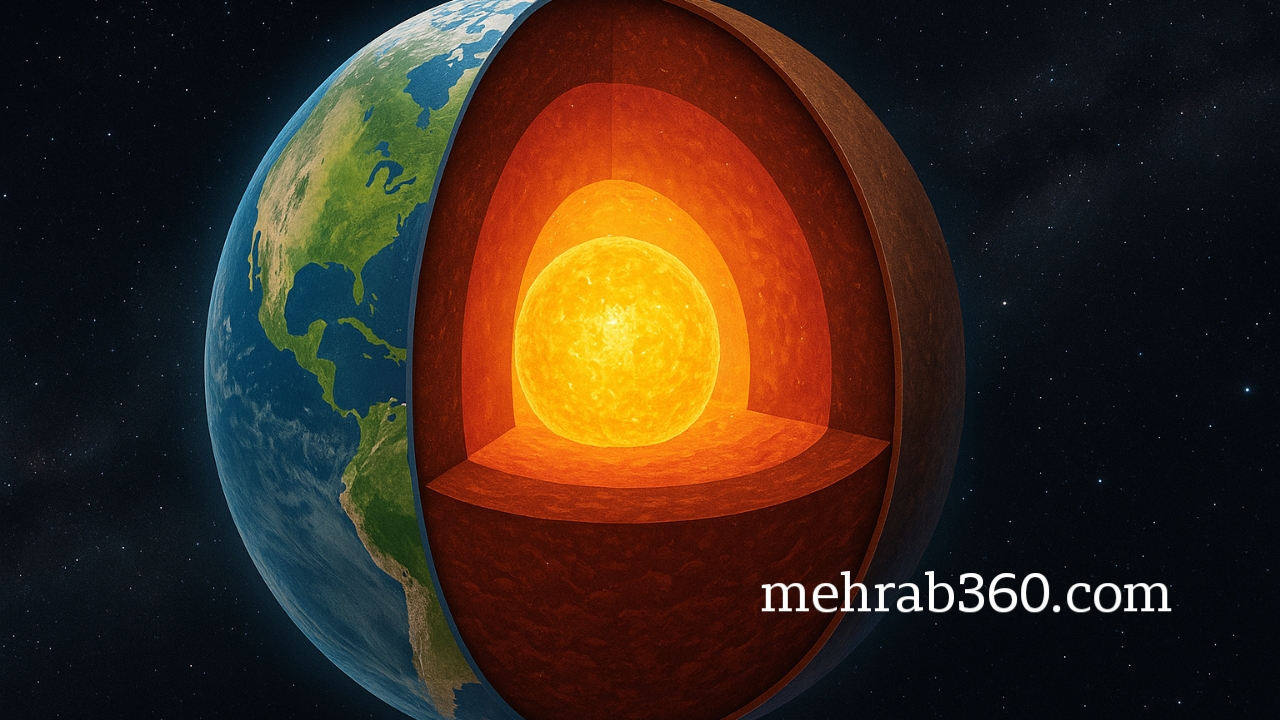
Earth Center Core
You can see the structure of the Earth’s crust, a cross-section of the Earth from space. The Earth’s solid inner core cannot be made of iron alone. So what else is there?
The iron-rich core at the center of our habitable planet is an important part of the Earth’s evolution. The core not only powers the magnetic field, which protects our atmosphere and oceans from solar radiation. It also influences plate tectonics, which has caused the continents to constantly rebuild. Yet scientists are still unsure about the core’s fundamental properties, such as its exact temperature, specific chemical composition, or when it began to solidify.
The inner core is estimated to have a temperature of about 5000 K (Kelvin) or 4727° C (Celsius), which was once completely liquid but has gradually cooled to a solid state, allowing heat to be transferred to the exterior, which drives mantle circulation and plate tectonics. The coolness of the core is also related to the production of magnetic fields, as energy is released from the liquid outer core to expand the solid inner core, and in this process, it is possible to get an idea of the nature of the core by analyzing seismic waves.
As seismic sound waves travel through the planet, they speed up and slow down depending on the material they pass through. The travel time of these waves, from earthquakes to seismometers, is compared experimentally with the speed of waves traveling through minerals and metals.
However, the density of the core is about 10% less than that of pure iron, suggesting that it is mixed with other elements. Meteorite analysis suggests that the core may contain small amounts of silicon or sulfur along with iron and nickel, but seismology provides more detailed information that shows that pure iron cannot explain these properties.
Studies that simulate how atoms in liquid metals combine to form solids have shown that some alloys require more intense supercooling than others. Supercooling is when a liquid is cooled below its melting point. The more intense the supercooling, the more atoms will combine to form solids, causing the liquid to freeze more quickly. A bottle of water in your fridge can be supercooled to -5°C for several hours before freezing, while water droplets in clouds cooled to -30°C will form hail within minutes.
Recent mineralogy research has shown that the supercooling process requires an additional cooling of about 1000°C to solidify pure iron, which is impossible and would in fact freeze the entire core. Adding silicon (Si) or sulfur (S) further increases this required cooling, and is therefore scientifically unacceptable. But the presence of carbon provides a viable solution; if the core contains about 2.4% carbon (C), supercooling to 420° C is sufficient, and if the carbon content is 3.8%, the required cooling drops to 266° C (C), which is relatively feasible. This is the first time that the presence of carbon has played an important role in the formation of the inner core. However, iron and carbon alone cannot explain all the seismic properties of the core, and at least one other element is required, with oxygen and silicon being the most likely. This discovery is an important advance in understanding not only the structure of the Earth’s interior but also its thermal history and physicochemical evolution.