

Science, technology and culture journalist Adam Rogers‘ grandmother has died. He has been tasked with cleaning his grandmother’s small apartment in Berkeley. He stops as he opens the door. It’s not an apartment, it’s a bookcase! Wall to wall, floor to ceiling; books everywhere. There are only two chairs to sit on, a small kitchen and a bed. Everything else is piled high with books.
The Apartment That Was a Library
At first glance, it may seem like utter chaos. But a closer look reveals otherwise. His grandmother was not only a labor leader, she taught library science at the University of California, Berkeley. She spoke five languages fluently. Even in her chaos, there was a strange order. Each shelf was organized by subject, each book by author.
Books as Living Conversations
While rummaging through the books, Adam discovered another mystery. Some of the books contained old magazines folded inside. The pages of The New Yorker, The London Review of Books, and Smithsonian Magazine were folded in such a way that the eye would be drawn to a specific article. That article must be relevant to the subject of the book. Going deeper, he found countless clippings filled with handwritten notes. In Grandma’s scrawl, she had jotted down the contents and sources.
It wasn’t just a library. Philosopher Mary Carruthers called it the architecture of memory. Grandma’s entire house was a map of her mind. French philosopher Jacques Derrida said, ‘An archive or a museum is like a promise to the future.’ But are all promises fulfilled? Towards the end of her life, Grandma’s fragile brain was no longer functioning as it once had. She herself could not understand the language of the empire she had created. Information theory says that for a message to be successful, the sender and receiver must agree on its language and time. Here, the recipient was her grandmother herself, but she was lost in the laws of time. As a result, it was not possible to recover the original message of his vast collection.
Sending messages from the past to the present or from the present to the future is not an easy task. When we look into the past, we see only what nature or a museum has kindly preserved.
Take a piece of stone found in Blombos Cave in South Africa, which is 73,000 years old. It has some triangles painted in red. Who painted it? Why did they paint it? Is it a picture of a mountain? Or an account of a seal hunt? Or was it a primitive man sitting on a lazy afternoon and drawing random lines? We will never know. The man who painted it may have had a lot to say, but we, the future generation, did not understand his language.
Most of what we know about the history of ancient Greece or Rome is thanks to the scholars of the Abbasid Caliphate in Arabia. We know Socrates or Plato because they retrieved and translated the scrolls from the Library of Alexandria. But how many thousands of scrolls have been lost? We know Ya-Nasir, a copper merchant in Babylon, only because of his business records written on clay tablets. But the names of many great kings and emperors of his time have been lost to dust!
Most of what we know about the history of ancient Greece or Rome is thanks to the scholars of the Abbasid Caliphate in Arabia. They rescued the scrolls from the Library of Alexandria and translated them.
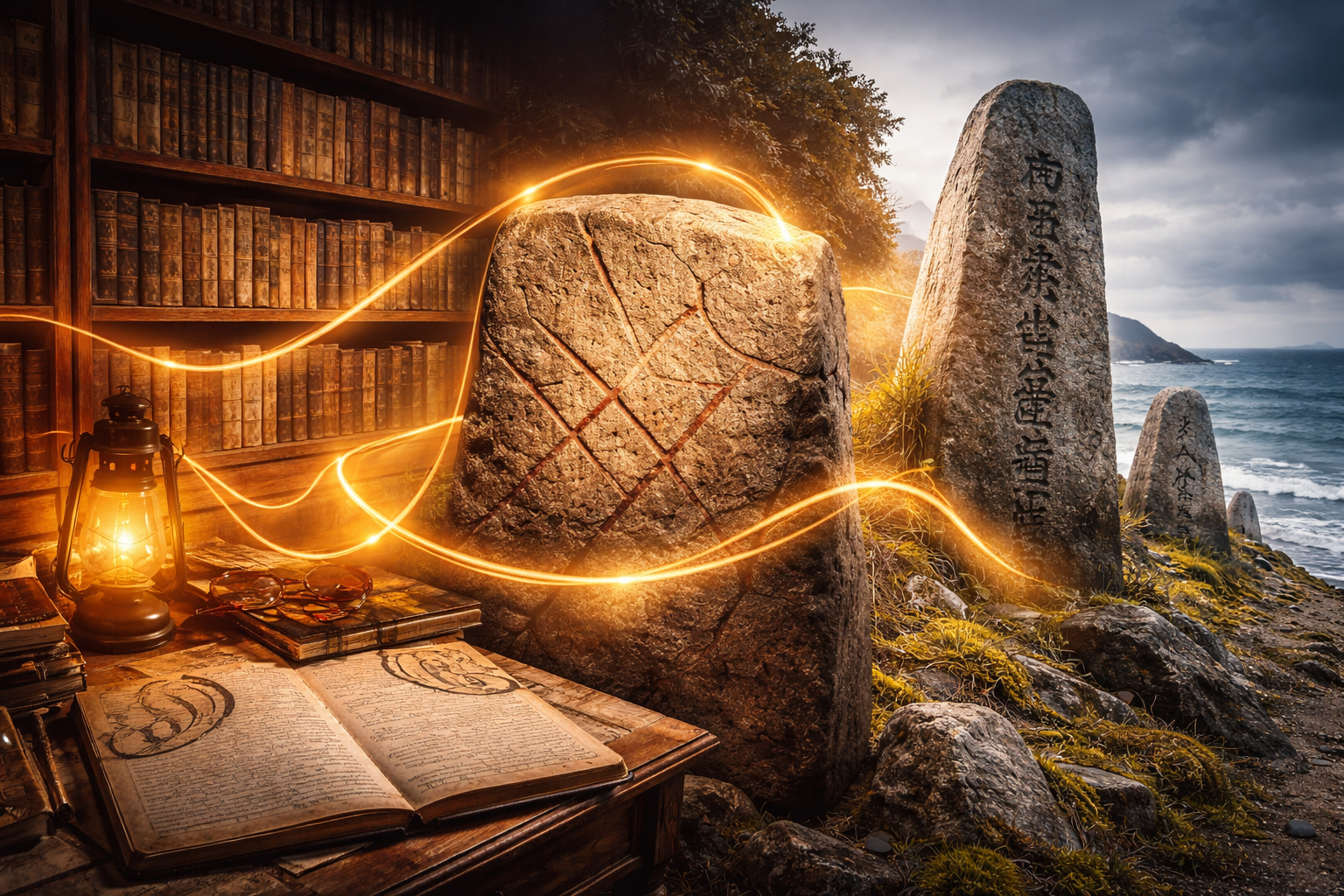
The most tragic example of leaving messages for the future can be seen on the northeastern coast of Japan. There, for 600 years, people have placed hundreds of tsunami stones. Each stone is like a warning. A stone in the village of Aneoshi is written about the flood of 1800. It is warned that no one should build a house under it. Another stone is written, in case of a tsunami, flee to Nokoria, or the Valley of the Survivors. But did people understand the language of those stones? More than 18,000 people died in the 2011 Tohoku earthquake and tsunami. They had built their homes on the same coast, under those rocks. The messages of the past could not save them.
But not all messages fail. In 1850, an engineer named James Francis built a dam in the American city of Lowell. The locals called it Francis’s folly. He feared that the Merrimack River would one day flood the city. So he built a huge gate and hung it with iron chains. The gate was so heavy that there was no mechanism to lower it. In 1852, a real flood came. A worker cut the chains with a hammer and dropped the gate, saving the city. Francis became a hero.
Fragile Promises to the Future
The story does not end here. In 1936, another big flood came. Francis was no longer alive. But the people of the city remembered that huge gate. They ran to the gatehouse. But there was no key! They broke down the door and went inside and saw a hammer hanging. On it was written, “Take the hammer.” Hit the pin.’ The man did just that. The chain broke and the gate fell. The city was saved again. The message Francis had left for future people was successful.