
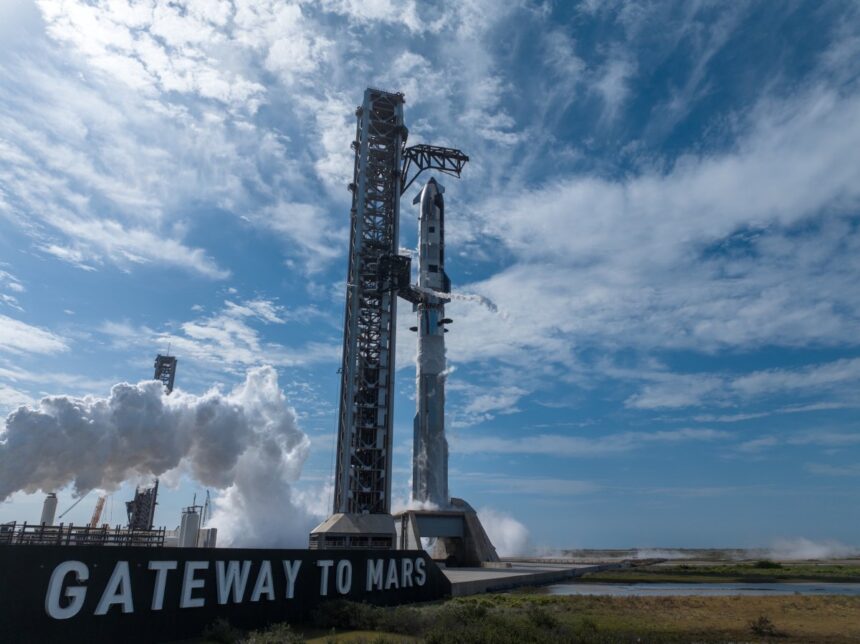
SpaceX has officially set May 19 for the long-delayed first launch of its next-generation Starship Version 3 vehicle, a mission considered vital for both the company’s future ambitions and NASA’s lunar exploration plans. The launch is scheduled from the Starbase facility in South Texas at 6:30 p.m. Eastern Time. The announcement followed a successful wet dress rehearsal conducted on May 11, during which SpaceX fueled both the Super Heavy booster and the Starship upper stage on the launch pad, after an earlier fueling attempt was reportedly cut short.
Ads
This mission, known as Flight 12, will mark the debut of Starship Version 3, featuring major upgrades to both stages of the rocket, including improved Raptor engines and the use of a newly constructed launch pad at Starbase. According to SpaceX, the primary objective of the test flight is to validate the redesigned Starship architecture in real flight conditions, with significant engineering changes focused on enabling rapid and full reusability based on lessons learned from years of development and testing.
Ads
The suborbital flight profile will resemble previous Starship tests but includes several key differences. Unlike earlier missions, the Super Heavy booster will not attempt a return to the launch site and will instead perform a controlled splashdown in the Gulf of Mexico. Meanwhile, the Starship upper stage will deploy 22 mass simulators representing next-generation Starlink satellites. Two of these payloads will carry imaging equipment designed to inspect the spacecraft’s heat shield during flight, helping SpaceX evaluate the shield’s readiness for future reentry missions and landings back at launch sites.
Ads
SpaceX also confirmed that Starship will relight a single Raptor engine while in space, continuing a test sequence attempted in previous missions. During atmospheric reentry, the spacecraft will intentionally perform high-stress maneuvers to test structural durability and simulate future landing profiles. Engineers have even removed one heat shield tile on purpose to study how aerodynamic forces affect neighboring tiles during descent.
Ads
The road to Flight 12 has faced repeated delays. Shortly after the final Version 2 Starship test flight in October, SpaceX initially targeted January for the next launch. However, the original Super Heavy booster assigned to the mission suffered damage during testing in November, forcing schedule changes. SpaceX CEO Elon Musk later predicted launches for early March, then early April, before eventually settling on the current May timeline. Neither Musk nor SpaceX has publicly detailed the exact causes of the delays, although the company recently released a documentary showcasing technical challenges involving both Starship testing and the new launch infrastructure.
Ads
Starship Version 3 is especially important because it is expected to become SpaceX’s primary operational rocket for orbital missions. The vehicle is intended to deploy future generations of Starlink satellites and also serve as the lunar lander for NASA’s Artemis missions. Speaking at a conference last November, SpaceX Vice President of Launch Kiko Dontchev described Version 3 as the company’s future “production rocket.”
Ads
In parallel with launch preparations, SpaceX has also addressed reports suggesting the company is exploring additional locations for Starship operations. Louisiana State Senator Bob Hensgens recently stated that either SpaceX or Blue Origin was interested in acquiring land near the Gulf Coast, including a massive 55,000-hectare property currently owned by Exxon. While SpaceX stopped short of confirming interest in the exact site, the company acknowledged it is actively searching for more launch locations to support its long-term goal of conducting thousands of Starship flights annually.
Ads
SpaceX emphasized that achieving such a high launch cadence will require multiple operational spaceports across different regions, both within the United States and internationally. Alongside Starbase in Texas, the company is already building a Starship launch facility at Kennedy Space Center’s Launch Complex 39A and two additional launch pads at Cape Canaveral Space Force Station’s Launch Complex 37.
Ads
Interest in international Starship launch operations is not entirely new. Back in 2017, Elon Musk introduced the idea of ultra-fast point-to-point travel using the vehicle now known as Starship, envisioning passengers flying from New York to Shanghai in roughly 30 minutes. However, such ambitions face major regulatory hurdles beyond technical development, including strict U.S. export control laws, missile nonproliferation agreements, and international technology safeguard negotiations that heavily restrict launch vehicle operations outside allied territories.