
Climate scientists have discovered major flaws in a global climate pollution database. A new study has found that the Climate TRACE consortium, co-founded by former U.S. Vice President Al Gore, significantly underestimates carbon dioxide emissions from urban vehicles by an average of nearly 70 percent.
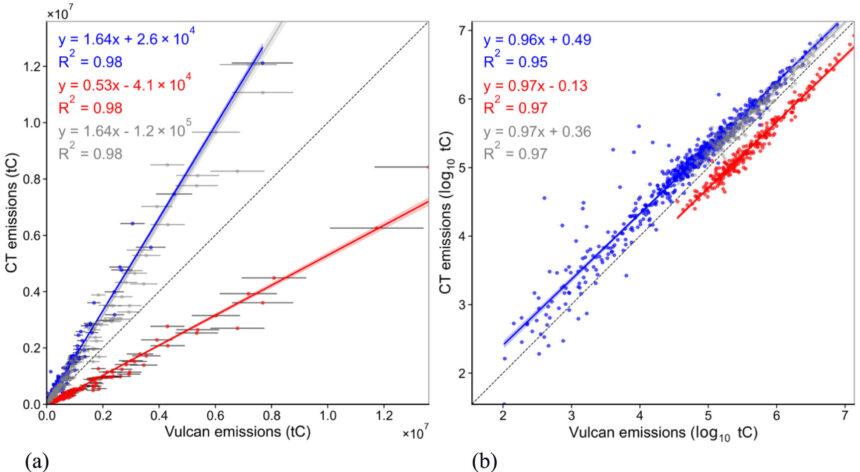
The research compared 2021 urban roadway FFCO₂ emissions from the Vulcan and Climate TRACE databases across individual metropolitan areas. The analysis included City Version 1, City Version 2, and the unscaled Climate TRACE Version 2 datasets. Researchers also evaluated Vulcan FFCO₂ 95 percent confidence intervals, linear regression equations and fits, R² values, and the 1:1 reference line. The study was published in Environmental Research Letters. DOI: 10.1088/1748-9326/ae6355
According to the new study from Northern Arizona University, the Climate TRACE database contains major inconsistencies in estimating vehicle emissions in cities. Kevin Gurney, a professor at the School of Informatics, Computing, and Cyber Systems, analyzed carbon dioxide emissions from cars and trucks using the recently released Climate TRACE database. He said the findings are consistent with previous research that identified similar discrepancies in power plant emissions, raising concerns about the reliability of greenhouse gas data used in climate policy.
Gurney explained that his team carefully examined the Climate TRACE data because of the importance of urban vehicle emissions. He noted that although the database relies on promising artificial intelligence-based methods, the results suggest that Climate TRACE substantially underestimates more than half of fossil fuel-based urban CO₂ emissions in the United States. Gurney and his team compared Climate TRACE urban vehicle CO₂ data with the Vulcan database, an independent “on-road” emissions system developed by his laboratory using official traffic activity and fuel consumption data.
Research co-investigator Bilal Aslam stated that while the Vulcan database itself has an uncertainty level of about 14 percent, the differences observed between Vulcan and Climate TRACE across 260 U.S. cities were far greater. According to him, Climate TRACE estimates were, on average, 70 percent lower than the corresponding Vulcan on-road CO₂ emissions.
Another contributor to the study, Pawlok Das, added that the discrepancy exceeded 90 percent in cities such as Indianapolis and Nashville. The researchers suspect that similar underestimation may exist globally and expressed broader concerns about other aspects of the Climate TRACE database.
The study emphasized that artificial intelligence has strong potential for environmental monitoring and emissions tracking. However, the researchers stressed that scientific rigor, transparency, and expert review remain essential for ensuring accuracy and maintaining public trust. Accurate greenhouse gas accounting is considered a critical foundation for effective climate policy.
The publication also proposed several recommendations for improving and advancing Climate TRACE operations to better support policy and budget decisions aimed at reducing emissions.
Gurney stated, “We may never estimate emissions perfectly, but we must ensure that the information shared with policymakers and the public is unbiased and meets the highest scientific standards. Without that, we risk misleading decision-makers and undermining public confidence in our ability to address climate change.”
An expert in atmospheric science, ecology, and public policy, Gurney has spent the past two decades developing standardized systems for estimating greenhouse gas emissions across the United States. His Vulcan and Hestia projects quantify and visualize emissions from power plants, neighborhoods, and roadways nationwide, helping identify emissions hotspots and enabling more effective mitigation strategies.
Publication details: Kevin R. Gurney and colleagues, “Evaluation of Climate TRACE Global On-Road CO₂ Emissions Accuracy,” Environmental Research Letters, 2026. DOI: 10.1088/1748-9326/ae6355